Alice Walton Does It Again: The Bentonville Medical Campus
Author
Phillip Shepard
Date Published
Alice Walton Does It Again: The Bentonville Medical Campus
I called this a cardiac facility. It is not, quite — and the distinction matters if you are the person who needs cardiac care and is trying to figure out where to go. There are two different projects here and I merged them.
1. The land — right about almost everything
The location checks out. About 100 acres roughly two miles east of downtown Bentonville, south and southwest of the I-49 and East Central Avenue interchange.
The multiple-sellers detail was right, and one of them really was a church. In July 2024, an entity called ALWF Lands LLC bought an adjacent 11.5 acres for $10 million from Catalyst Church NWA. In April 2025, AWSOM Lands LLC bought 50.77 acres for $18.51 million — about $365,000 an acre — from a Bentonville landowner. Those, plus other parcels, made up the assembled site, announced by the Foundation in February 2025.
The subdivision I mentioned has a name: Blueberry Heights, which borders the site on two sides. I said neighbors were "actually happy about this because it's just been kind of dead land." I should not have spoken for them. Local coverage at the time described the development as stirring mixed emotions among neighbors — some residents had backyards facing pastureland and were losing that. My joke about wheeling Grandma across the road was fine as a joke. Presenting neighborhood sentiment as settled was not my call to make.
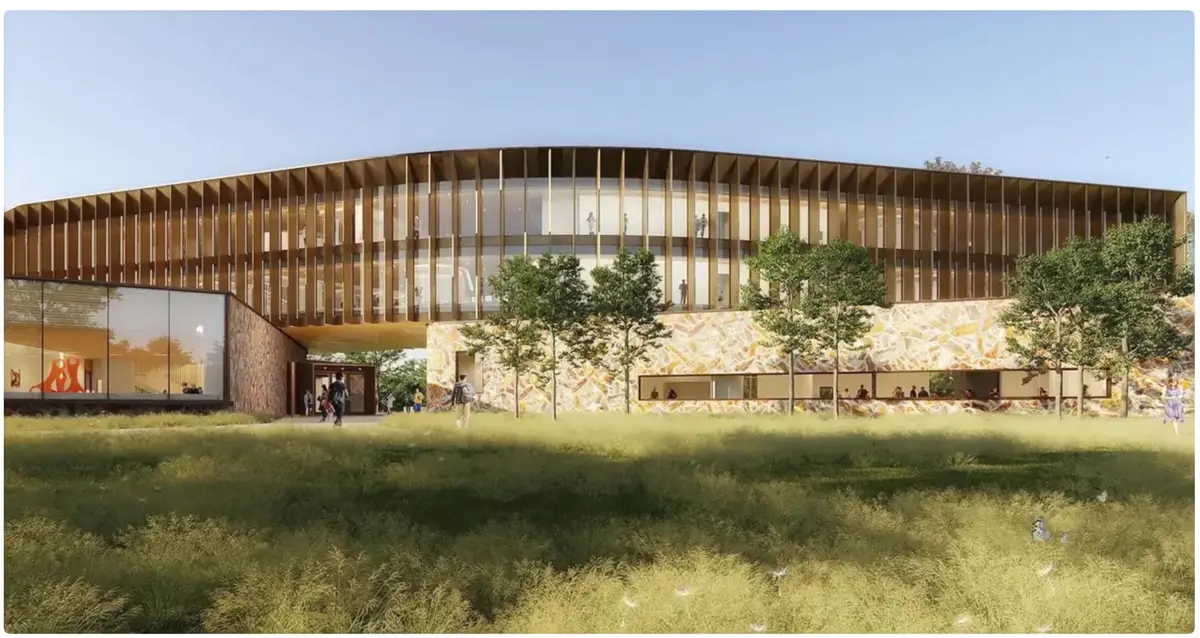
Now the correction that matters. I said "this is going to be a cardiac facility." Phase 1 of the Bentonville campus is a Center for Advanced Specialty Care — outpatient specialty services, including cardiac, plus a parking garage, a central utility building, gardens and trails.
The dedicated cardiac Center of Excellence is a separate project on Mercy's Rogers campus. That is the hospital-level, inpatient and surgical cardiac center. Two different sites, two different levels of care. If you need a cardiologist in 2029, knowing which building does what is the whole point.
2. The $700 million — and I was right about Cleveland Clinic
My hedges here served me better than my confidence usually does, and they turned out right.
I said "Mercy coughed up about I think 300 something million dollars." Mercy committed exactly $350 million, funding the Rogers cardiac center plus physician recruitment. The Alice L. Walton Foundation committed a matching $350 million for the Bentonville campus. That is the $700 million.
And on Cleveland Clinic I said: "I don't think they kicked up any money, but I know that they are letting everyone take their information essentially and build brand with Cleveland Clinic."
That is accurate. Cleveland Clinic's own announcement names no financial commitment from Cleveland Clinic. Its contribution is cardiovascular clinical expertise, protocols, best practices and national cardiology leadership on site, plus co-branding the Mercy Rogers center. The two funders are Mercy and the Foundation.
I flagged that as a guess. It was right, and it is a genuinely useful thing to understand about how these partnerships are structured — one partner brings capital, another brings a name and a clinical playbook.
3. The payment-model claim was real, not speculation
I said Alice Walton "wants to change the way medical payments are done in Arkansas to be a... gold standard or a different way of doing things to... combat the medical structures of America in general." I said it in the same breath as calling something else a conspiracy theory, so it may have sounded like more speculation.
It is documented. Heartland Whole Health Institute works directly with payors, providers and policymakers on value-based payment transformation — tying payment to outcomes rather than volume — and runs an Arkansas Health Care Transformation Demonstration Project explicitly designed as a replicable national model. Walton's own language in the September 2024 announcement was about making accessible, value-based care a reality.
So the payment-reform piece is not a side effect of building hospitals. It is a stated objective.
4. Her age, and a timeline I should not have put in her mouth
I said "she is 75" and "her plan is 30 years."
The age was right at the time. Alice Walton was born October 7, 1949, so she was 75 when I recorded this and is 76 now.
The 30 years is half right, and the half that is wrong matters because I attributed it to her personally. The $700 million initiative is formally structured as a 30-year affiliation — that is real, and it is where the number comes from. But I framed it as her personal plan, and in her own public remarks she said something different and more interesting.
At Build Bentonville in March 2025, she invited the audience to welcome her back in 15 years to review results, drawing the comparison to Crystal Bridges, which she had envisioned roughly 15 years before it opened in 2011. As her remarks there were reported, she framed the goal in terms of access rather than timelines — saying that access to transformational health care was the thing this region was missing, and that she intends to fix it.
30 years is the contract. 15 years is what she said she wants to be judged on.
5. Washington Regional is not part of the university
I said "we already have Washington Regional, which is attached to the university." That is wrong, and it is the kind of wrong that could affect a real decision.
Washington Regional Medical System is a community-owned, independent, locally governed nonprofit. It is not owned by, or corporately part of, the University of Arkansas or UAMS.
What exists is an academic partnership with the UAMS Northwest Regional Campus for graduate medical education — joint residency programs in internal medicine, and newly accredited neurology and emergency medicine residencies as of April 2025, working toward as many as 92 residency positions by 2030.
Three separate institutions: Washington Regional, UAMS Northwest, and the University of Arkansas in Fayetteville. Teaching partnerships between them are real and valuable. Ownership is not the same thing, and I described one as the other.
6. The state ranking, the obesity point, and my five-year prediction
On the rankings, I said "49th, 48th, 50th... they're fighting for the bottom." Close, and worth stating precisely: Arkansas ranked 48th on America's Health Rankings in 2024 and 49th in the 2025 report released this January, ahead of only Louisiana. The Commonwealth Fund's 2025 scorecard has it 48th. No major current ranking puts Arkansas dead last.
On obesity, I said "obesity, you name it, Arkansas got it." The adult obesity rate is 38.9 percent, fifth-highest in the nation per CDC data published in October 2025. That is a serious number and my offhand delivery undersold it.
And my prediction needs walking back. I said we would have "top tier medical in the next like less than five years."
Phase 1 of the Bentonville campus targets December 2028. Designers were only named in November 2025 — CannonDesign with EDSA on landscape and Polk Stanley Wilcox as Arkansas architect of record — with construction starting in 2026. As of the most recent reporting there had been no groundbreaking.
So one building may open inside my five-year window. The thing I was actually promising — a transformed regional health system — is a 30-year affiliation by its own terms, and its principal funder asked to be judged in 15.
That is not a knock on the project. It is a very large, very serious, very long undertaking. I just told you it would be finished in five years, and nobody involved has ever said that.