The Medical School Housing Isn't Free — I Said It Was
Author
Phillip Shepard
Date Published
I can't find any evidence that the housing next to the medical school is free. I said in this video that the school "can have free tuition, free housing," and I've said versions of it in other videos. The tuition part is true and better than I described. The housing part I have not been able to source at all, and I want to flag that plainly, because a prospective student could build a budget around it.
One note on where my information came from: I mentioned in the video that "I've talked to a lot of people who work at the Alice Walton School of Medicine." That's true, and it's probably where some of this came from. Conversations aren't citations, though, and I presented what I'd heard with the confidence of something published.
What's verified
Everything in this section comes from the school's own published materials and press coverage rather than from my conversations.
Preliminary accreditation. Real. The Alice L. Walton School of Medicine received preliminary accreditation from the Liaison Committee on Medical Education in October 2024, per the school's announcement. That's the step that let it enroll anyone, and I was right that it's a demanding process.
I said it "has been a three-year long process so far." I couldn't verify that specific duration, so treat it as my impression rather than a documented timeline. What is documented is the outcome and the date.
Students starting in 2025. Right on time. The inaugural class of 48 students began on July 14, 2025, selected from more than 2,200 applicants. The founding dean and CEO is Dr. Sharmila Makhija, who came from Albert Einstein College of Medicine and Montefiore in the Bronx.
Tuition free. True, and I undersold it. I framed it as a temporary startup measure — "it's hard to charge money for that, I assume" — and predicted "it wouldn't shock me all that much if they ever charge." The published commitment is that tuition is free for the first five cohorts. That's a stated multi-year policy, not a soft launch.
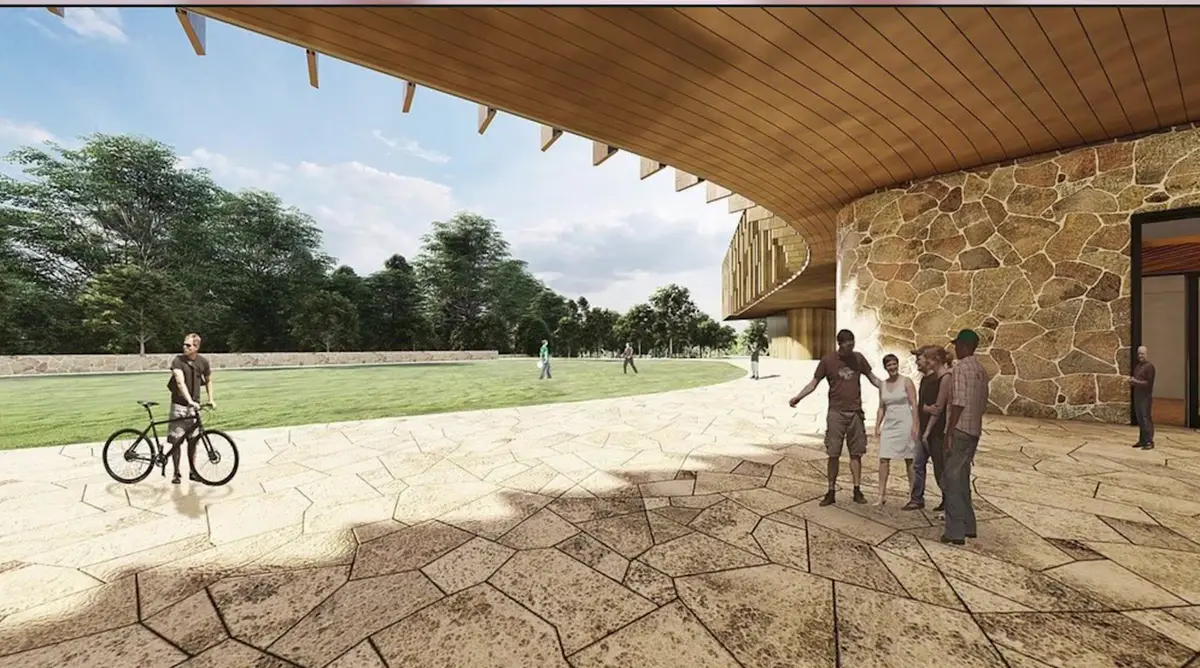
The 300-unit complex. Real. It's going up on an adjacent 11-acre site, with one building for students and one for the community, expected to open in 2026.
Where "free housing" comes from, and why I'd drop it
I think I reasoned my way there. The logic in the video is explicit: the school owns the land, it's giving away tuition, it wants no barriers to entry, therefore housing must be free too. It's a plausible chain. It just isn't reporting.
I found nothing indicating the housing is free or subsidized. What the descriptions actually show is rental housing on an adjacent site, one building of which is for the general community — which is not how you'd structure a student benefit.
So the honest version for anyone weighing this school: assume free tuition, and assume you pay rent. If the school announces a housing benefit later, that's upside. Don't plan on it now.
I also speculated on camera that students might do "clinical stuff in the local area — at Washington Regional, at Bentonville hospitals, over at Mercy... in exchange for housing." I flagged that as a guess and it should stay one. Clinical rotations are a normal part of medical education everywhere; there's no indication they're bartered for rent here.
One thing worth knowing that I didn't mention: the school sits inside a much larger arrangement. In September 2024 the Alice L. Walton Foundation entered a 30-year, $700 million collaboration with Mercy and Cleveland Clinic. That partnership is where a lot of the clinical infrastructure comes from, and it's a more concrete answer to "how does this work" than my speculation was.
The completion date slipped
I said "this is all going to be done in 2025." The expected opening is 2026. Not a big miss, but if you were timing an application around move-in, it matters.
I also named a nearby comparable that comes out of my audio as "the Crystal Flats." Update: an earlier version of this post said I couldn't confirm a Bentonville complex by that name and advised leaving it out. That was my mistake — Crystal Flats is real. It's a 622-unit complex at 1401 NE John DeShields Blvd, built in 2021, near Crystal Bridges and the Momentary. A search that comes up empty isn't proof a thing doesn't exist, and I stated it more confidently than I'd earned.
On the part about her age
I said the school "will be a huge benefactor, I would assume, in the next like probably 25 to 50 years, which she's not going to be alive in that time. So this is definitely a legacy thing for her."
I'd cut that. Speculating about a living person's mortality on camera isn't something I need to do to make the point, and the point stands without it: an institution designed to change how physicians are trained pays off across decades, not quarters. That's true of every medical school, and it's why founding one is a different act than funding a building.
The framing I'd keep, with one adjustment
I described the school's approach as making sure "you are both healthy body and healthy mind, and if medicines evolve, great, if not then we don't necessarily need to go down that path."
That's a fair summary of the whole-health premise. The adjustment I'd make is to be careful with the implied contrast. Here I called it "whatever 50 pills you need," and in another video on the same subject I described conventional practice as "just shoving pills down people's throat." That's a caricature of a field that also does surgery, diagnostics, vaccination and emergency care rather well. A new school built around treating the whole person is a genuinely interesting bet. It doesn't require the rest of medicine to be a pill dispensary.
For the fuller correction on this school — including a separate video where I introduced Alice Walton as the CEO of Mercy, which she is not — see my earlier post on the medical school.