Cleveland Clinic Isn't the Best Hospital in the World
Author
Phillip Shepard
Date Published
Cleveland Clinic is not the best hospital in the world. I opened this video calling it "the Cleveland Clinic, known as the best hospital in the world," and put it in the title.
On Newsweek's World's Best Hospitals 2026 list, Mayo Clinic in Rochester is first — for the eighth straight year — with Toronto General second and Cleveland Clinic third. On the US News Honor Roll it made the list for a 35th consecutive year, which is its own remarkable streak, but not a number one.
Here's the thing that makes this correction better than the claim: Cleveland Clinic has been ranked the number one heart hospital in the country for 30 consecutive years. And what they're building here is a cardiac center.
So the accurate line was available and it's stronger. Not "the best hospital in the world is coming to Bentonville," but "the hospital that has been number one in cardiology for three decades is putting its name on a heart center in Rogers."
The $350 million split was right; the entity was wrong
I said "$350 million is coming from Alice Walton School of Medicine, and then there's another $350 million coming from the Mercy side."
The dollar figures are correct. The attribution isn't.
The money comes from the Alice L. Walton Foundation, not the Alice L. Walton School of Medicine. Those are separate entities. The school opened in July 2025 with 48 inaugural students, and Mercy is its primary clinical and educational partner — but the school isn't a funder in this deal.
The full arrangement, announced September 24, 2024, is a 30-year, $700 million affiliation among the Alice L. Walton Foundation, Mercy, and the Heartland Whole Health Institute, with Cleveland Clinic collaborating.
What each half builds:
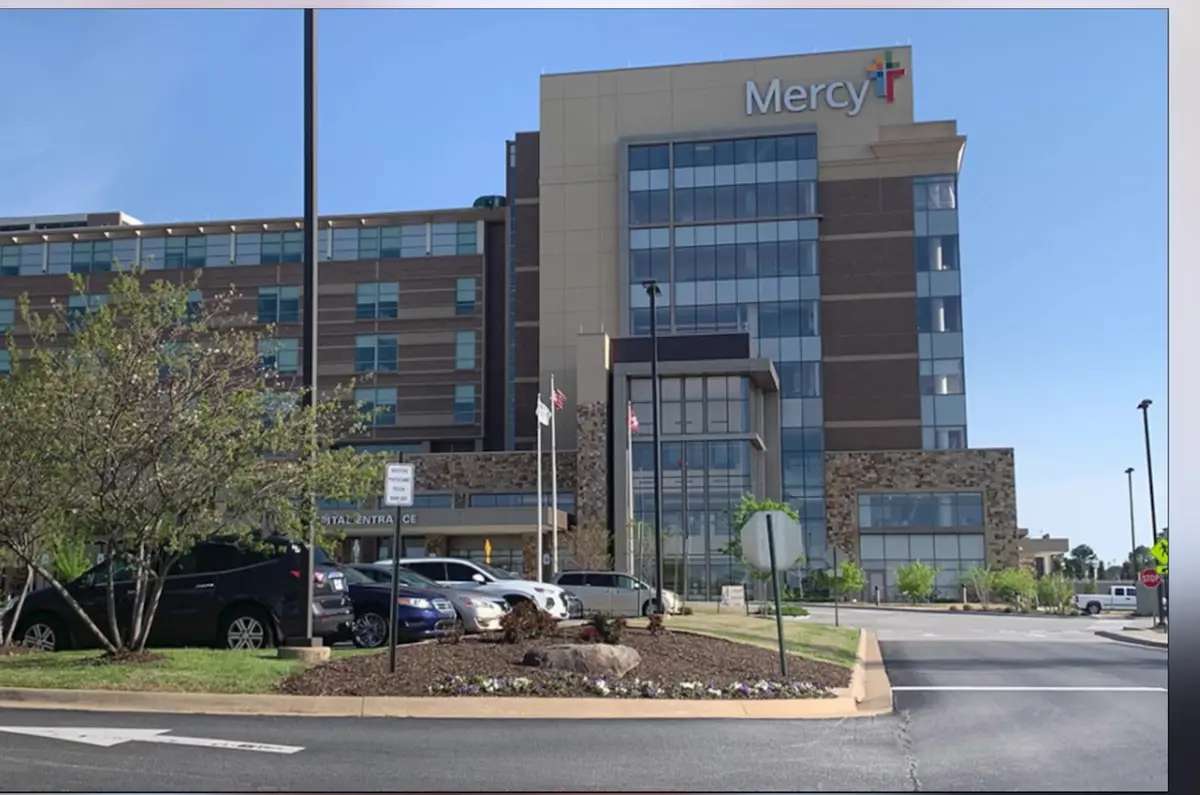
- Mercy's $350 million goes to a new cardiac care center of excellence on Mercy's existing Rogers campus, plus physician recruitment.
- The Foundation's $350 million funds an outpatient center of excellence in Bentonville for specialty care, cardiac services and virtual care. The Foundation bought 100 acres for that campus in February 2025, with an opening targeted around 2028.
I described it as going "into both the Mercy Hospital Rogers as well as a new clinic up in Bentonville," which is right in shape.
One more thing to untangle. Later in the segment I listed regional investments including "Mercy dedicating another $700 million — a different thing — on more advancements." I don't think that's a different thing. I can find one $700 million commitment here, the September 2024 affiliation, and I appear to have counted it twice: once as the headline announcement and once as a separate Mercy initiative. If there's a second $700 million Mercy program in Northwest Arkansas, I couldn't find it.
"Co-brand" was exactly the right word
I said "the Cleveland Clinic has been brought on to be like, we are going to endorse and co-brand all of this together." That's accurate, and I want to flag it because it's the kind of precision that's easy to lose.
Cleveland Clinic's role is a clinical and advisory collaboration. It contributes cardiovascular expertise, best practices and process design, and it will co-brand the cardiovascular center on Mercy's Rogers campus. It is not ownership, not management, not a merger. Cleveland Clinic's own release uses "co-brand."
A lot of people hear an announcement like this and assume the famous hospital is taking over. It isn't. Mercy still runs Mercy.
Where I overstated the exclusivity
I argued that "Cleveland Clinic doesn't go around to any willy-nilly area and [say] I'm going to co-brand here. It's very specific. I mean, they have places over in Abu Dhabi, over in the Middle East, in very wealthy, well-known places where they can afford healthcare like that."
The owned footprint does skew that way — the main campus in Cleveland, Weston in Florida, the Lou Ruvo Center in Las Vegas, Toronto, Abu Dhabi and London.
But Cleveland Clinic also runs a standing affiliate network for exactly this kind of arrangement, including a program called Cleveland Clinic Connected, whose members include ordinary community health systems — Columbus Regional Health in Indiana joined in January 2025. Historically Cleveland Clinic has maintained twenty to thirty-plus hospital affiliations across multiple states.
So this fits an established business pattern rather than being an exception carved out for a wealthy patron. That doesn't make the Northwest Arkansas deal unimportant — a 30-year, $700 million commitment is substantial by any measure. It just isn't the "they only go where the money is, so this proves something about us" argument I made.
The cardiac center isn't starting from zero
I described the project as adding a cardiac center, which reads like the region is getting one for the first time.
Mercy already operates the Mercy Heart and Vascular Center – Northwest Arkansas in Rogers. It does open-heart surgery and angioplasty, ran Northwest Arkansas's first TAVR program, offers the Watchman device for atrial fibrillation, and has cardiac rehab, an eleven-bed dedicated cardiac procedure unit and an imaging suite.
So this is a significant expansion and upgrade of cardiac capability that already exists, with Cleveland Clinic's name and expertise attached. Which is still a real story — I just made it sound like there was nothing here before.
The 49th ranking is right, for one scorecard
I said "if you type in Google what is the healthcare like in Arkansas, it's literally 49th."
That checks out — for America's Health Rankings, published by the United Health Foundation, where Arkansas placed 49th of 50 in 2025, down from 48th in 2024.
Two other major scorecards put it differently. The Commonwealth Fund's 2025 State Scorecard has Arkansas 48th overall, with particularly rough sub-measures: 50th in premature deaths from treatable causes, 49th in infant mortality, 50th in preventive cancer screening. US News ranks Arkansas 47th on health care.
So the honest framing is 47th to 49th depending on what's being measured, and I'd say that rather than picking the worst number. It doesn't change the point — Arkansas ranks near the bottom on every one of them, and that's the gap this investment is aimed at.
"Very rarely do they have to travel outside" needs a number
I said of my older clients: "very rarely do they have to travel outside of Northwest Arkansas to get the care they're looking for."
The Northwest Arkansas Council's own research says otherwise. Out-migration for care ran around $950 million a year at the time of the 2019 assessment. By 2023 it had fallen to about $695 million a year — real progress, and the whole point of the transformation effort.
But $695 million a year is not "very rarely." People are still leaving this region for care in substantial numbers, and the Council's 2024 Vision 2030 report still flags expanding specialty services as a priority.
My clients' experience may well be exactly what I described. It's just not the regional picture, and I presented one as the other.
Two framings I'd change
The pills line, for the third time. I said the whole-health approach means "not just necessarily shoving pills down your throat if you have issues. It's the whole health: the mental, the physical, the emotional, everything."
I've now used some version of that in at least three videos, and I'd retire it. A new medical school built around treating the whole person is a genuinely interesting bet. It doesn't require caricaturing a field that also does the open-heart surgery I just spent a section praising.
And the mortality framing, also for the third time. I described Alice Walton as "spending a lot of her money, a lot of her wealth as she gets up in age, in getting these systems set up for the area that will honestly way outlast her."
I keep reaching for this and it keeps being unnecessary. The point — that institutions like these pay off across decades, not quarters — stands on its own. That's true of every medical school and every hospital, and it's why building one is a different act than funding a building.
What holds up
The core of the segment survives everything above. A 30-year, $700 million commitment is real. The split is real. Cleveland Clinic's involvement is real and correctly described. And the multigenerational argument I closed on — that people considering a move here want to know whether their parents can get care too — is the right question to be asking, and better care in cardiology is a real answer to it.
I'd just deliver it with the actual numbers: Arkansas ranks in the high forties nationally, roughly $695 million a year still leaves this region for care, and the hospital lending its name here has been number one in heart care for thirty years.