Downtown Springdale Didn't Start Five Years Ago
Author
Phillip Shepard
Date Published
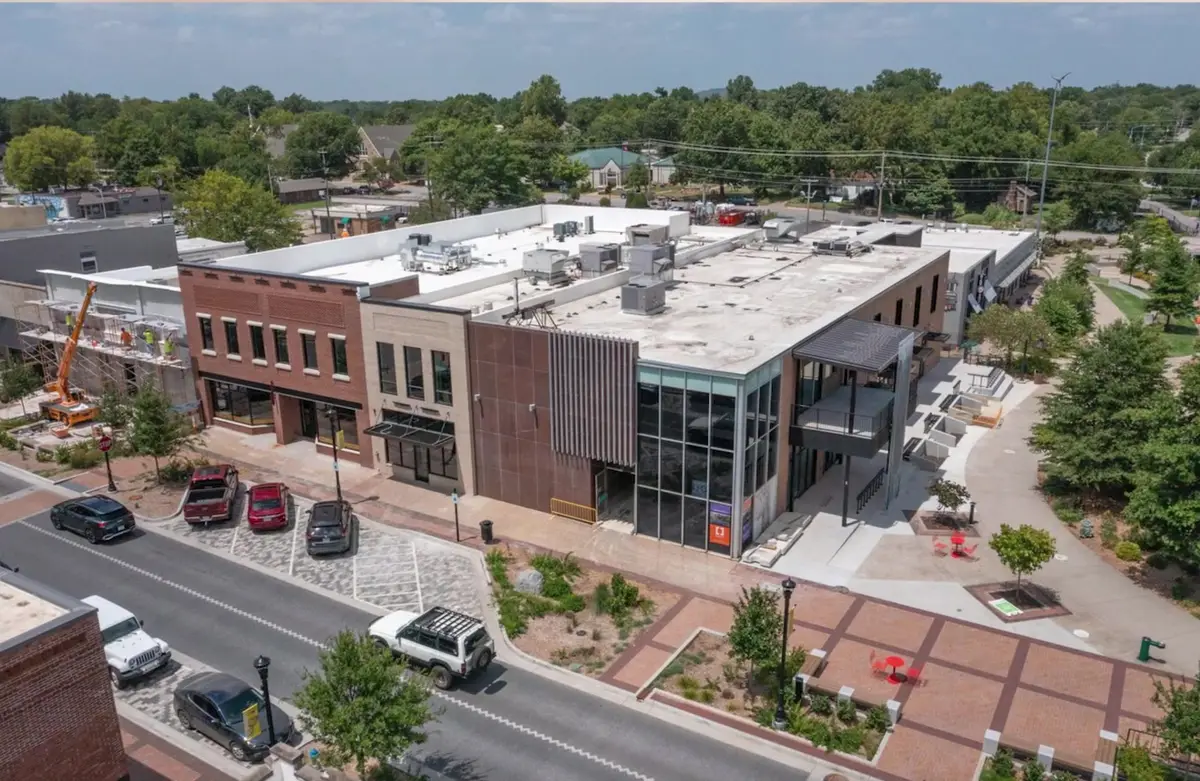
The groundwork for downtown Springdale was laid a decade ago, not five years ago. I said "Springdale 5 years ago, nothing was going on there, I promise you that." The Razorback Regional Greenway opened through downtown in 2015, the Downtown Springdale Alliance formed the same year, and the Emma Avenue streetscape, Walter Turnbow Park and the Apollo Theater renovation all came out of that stretch.
To be fair to my own claim: five years ago most of what you can walk into today hadn't opened yet, so the feeling of sudden arrival is real. What's wrong is the implication that nothing was happening. This was a decade-long effort finally opening its doors, and the distinction matters because it changes who gets credit.
Let me go through the projects, several of which I shortened or got slightly wrong.
The names
Luther George Park — right name, and my timing was right when I filmed. The reopening was a two-day event on October 11 and 12, 2024, after breaking ground in October 2022. It's about 14 acres, billed as the largest downtown green space in Northwest Arkansas, and it cost $12.5 million through a capital campaign led by the Downtown Springdale Alliance.
The detail I completely missed: it was designed by Trahan Architects of New Orleans and New York with landscape architects Spackman Mossop Michaels. The centerpiece is a performance pavilion — a roughly 45-meter undulating weathering-steel canopy, one centimeter thick, touching the ground at only two points, facing a great lawn that seats around 3,000. That's a genuinely remarkable piece of architecture in downtown Springdale and I described it as "a really interesting design."
"The Market of the Ozarks" is Market Center of the Ozarks. It opened May 29, 2025 — $31 million, about 45,000 square feet.
"Onyx Coffee House" is Onyx Coffee Lab, the Rogers-based roaster. The Springdale location is at 100 W. Emma Avenue and opened in May 2025.
"The Hideaway" — I had this one right, and it's the project I most underdescribed. More below.
"Star on Spring" is The Star on Spring, at 101 Spring Street.
Two things I got substantively wrong about the Design Excellence program
I said Luther George was "sponsored through the Walton Foundation, known as part of their Excellence program," described it as hiring "the best architects in the world and make them fight against each other," and said "there's only been a couple Excellence programs done in Northwest Arkansas."
It's the Northwest Arkansas Design Excellence Program, launched by the Walton Family Foundation in 2015. As of December 2024 it had funded design for 20 projects with $28 million, leveraging roughly $141 million in other funding — Railyard Park in Rogers, Thaden School, The Ramble in Fayetteville, TheatreSquared and Bentonville City Hall among them. Not a couple.
And it's not a competition. It's a pre-qualified roster. A selection committee chaired by the dean of the Fay Jones School of Architecture and Design vets firms, which are admitted for rolling five-year terms. When a grantee has a project, the committee presents a small pre-screened group and the grantee interviews and chooses. Being on the roster doesn't even guarantee an interview. One of the program's stated principles is pairing outside firms with local ones — the opposite of making them fight.
Also worth being precise: the foundation grant funded the park's design. Construction money came from the broader $12.5 million campaign, and the park is named for Luther George of George's Inc., which sponsored the reopening.
What Market Center of the Ozarks actually is
I described it as a place for farmers to "prep" food, bridging farmers and restaurants. That's part of it, but it's three things at once.
It houses the Arkansas Food Innovation Center, a University of Arkansas System Division of Agriculture shared-use commercial kitchen with food processing and bottling plus training for food entrepreneurs. And the Spring Creek Food Hub, which handles aggregation, cold storage and distribution connecting farmers to restaurants, schools and institutional buyers.
So: commissary kitchen, aggregation hub, and education. It came out of the Walton Family Foundation's Northwest Arkansas Food Systems initiative, begun in 2020.
100 West Emma isn't all food and beverage
I said the building is "leveraged all for food and beverage." It's mixed-use. The architect, Cromwell Architects Engineers, took the second floor as its own regional office with around 30 workstations.
The building is the former First Security Bank regional headquarters, bought with associated parking lots for $4.96 million in June 2022 by a group including Ken Hall, Don Harris and Tom Lundstrum. The renovation broke the facade into what reads as three separate downtown storefronts.
I couldn't verify the 35,000 square feet I quoted, so treat that as unconfirmed.
The steakhouse has a name: Gaskins on Emma, 3,335 square feet on the first floor, from Lisa Provencio-Jones and Bert Jones, who have run Gaskins Cabin Steakhouse in Eureka Springs for years.
And the chocolate bit was right. Onyx Coffee Lab's Springdale shop is its chocolate-focused concept — a bean-to-bar production facility visible from inside the three-story cafe, roasting cacao and developing single-origin chocolate. I said "when you taste the chocolate your life changes," and I'd said a moment earlier that I'm "not a coffee connoisseur, not a chocolate connoisseur." Both still true. I'll stand behind the review anyway.
The Hideaway is a much better story than I told
I said it's "14 smaller style homes kind of pushed together in almost like a community living style," and framed it as an experiment in density.
The best figure I can find is 10 homes, on a site that previously held two houses. Developer is Allengrove. They're two-story cottages around a shared court with front porches, 10-foot ground-floor ceilings, and an HOA maintaining common grounds and a fire-pit area.
Here's what I left out entirely, and it's the whole point: these are for sale, and they're permanently affordable through a community land trust. The base price to an eligible buyer is about $160,000, with roughly $90,000 in affordability assistance delivered through the trust. Buyers must meet income limits.
I framed this as a design experiment about whether people want yards. It's an affordability mechanism. That's a much more interesting thing to be building in a downtown that's attracting investment.
The Star on Spring is a hotel, not an Airbnb
I called it "an upper echelon Airbnb." It's a licensed, staffed 13-room luxury boutique hotel — one ADA room, five standard, four deluxe adjoining and three suites. It opened July 23, 2025, directly across from Walter Turnbow Park and the Razorback Greenway.
The distinction matters for a couple of reasons. A hotel is a permitted commercial lodging use downtown and doesn't face short-term-rental questions at all. And "Airbnb" implies self-check-in and no staff, which is not what you're booking.
The building is the former Star Automobile showroom, built in the 1920s — that's where the name comes from, not from star ratings. The renovation keeps the 1920s bones and layers in Art Deco. Onyx supplies the in-room coffee and chocolate.
I couldn't verify the 10,000 square feet I quoted.
Big Emma: right numbers, wrong organization
I got the headline figures right. Big Emma at 627 E. Emma Avenue is 77 units across three three-story buildings — 57 one-bedroom and 20 two-bedroom — on 2.6 acres, with two ground-floor commercial spaces. And 30 of the 77 are permanently reserved for households earning below area median income. My "I believe 30 units are permanently going to be" was accurate, including the permanence.
But I credited it to the wrong organization. I said it was the Northwest Arkansas Council's project — "one of their top-tier projects currently."
It's a private development by Shiloh Capital, the same group behind 100 West Emma, roughly $17 million, with Buffalo Builders. The permanent affordability is held and managed by Community Development Northwest Arkansas, a regional nonprofit housing developer. The Council's connection runs through Groundwork, its affiliated housing initiative, which put in a $6.75 million grant from the Walton Family Foundation to buy down the 30 units.
So Groundwork is one funder among several participants. The Council itself is a private business league with no governmental or land-use authority — it convenes, funds and advocates. It doesn't approve or build.
Credit where it's due on that segment: I disclosed my own position before setting it aside — "I'm not always in favor of like subsidized housing, but it is nice to see organizations step in" — and then explained why I'd made an exception. Telling people where you're coming from before you argue is the right instinct.
One word I'd change: I said "subsidized housing." These are attainable or workforce units at below-market rents held by a nonprofit, not government-subsidized vouchers. Different mechanism, and the distinction matters to how it works.
I also couldn't confirm which area-median-income bands apply, so I won't guess at a percentage.
The senior center is public money, and that's the point
I described the new Springdale Senior Center as "two stories" with pickleball courts and fitness rooms. It opened with a ribbon cutting on September 9, 2025: 40,000 square feet, $14 million, roughly twice the size of the old center, with indoor pickleball courts, a fitness center, game rooms, work stations, meeting rooms and a hair salon. Architect CORE Architects, builder Buffalo Builders. It sits across from The Jones Center.
I couldn't confirm the two-story detail, so I'd drop it.
The thing worth saying that I didn't: this was funded as a 2023 city bond project. Everything else on my list traces to Walton or private money. The senior center is Springdale taxpayers deciding to build it themselves. That's a genuinely different fact, and it strengthens the point I was trying to make — that the city isn't letting downtown become only Airbnbs and steakhouses.
The thing I left out of a video about Springdale
I never mentioned who lives there.
Springdale is roughly 42% Hispanic or Latino — the highest share of any major city in Northwest Arkansas — and it is home to the largest Marshallese population in the continental United States, with estimates commonly cited between 10,000 and 15,000 in the region. The Marshallese community is here because of the Compact of Free Association, signed in 1986, which lets Marshallese citizens live and work in the US without a visa, and because of poultry-industry employment.
(A note on those figures, since they can look like they don't add up: the Census counts Hispanic or Latino as an ethnicity separate from race, so a resident can be counted in both. The city was 99.9% white in the 1990 census and is roughly 60% white now — a shift that overlaps with, rather than excludes, the Hispanic share.)
That's not a footnote to downtown Springdale. It's the substance of it. Reporting on the Emma Avenue revival describes the mix as a young creative class alongside a growing Hispanic and Marshallese entrepreneur class.
And it complicates my "downtown Springdale is becoming downtown Bentonville" framing. What makes Springdale interesting is precisely what that comparison erases.
There's also a concern I should have raised. The neighborhood bounded by Emma Avenue, Holcomb Street, Robinson Avenue and the municipal airport has long housed low-income families. Reporting in 2023 quoted residents worried that new investment would raise property values past what they can afford, and noted they were already getting mailers from investors offering to buy their homes. That's a recognizable early signal.
The counterweight is real too, and it's part of why I find Big Emma and The Hideaway more interesting than I did when I filmed. Thirty permanently affordable units held by a nonprofit, and ten permanently affordable homes in a land trust, is a materially stronger anti-displacement posture than most gentrifying downtowns manage. Springdale is at least trying to build the affordability in on the front end.
I'd rather present both of those than only the ribbon cuttings.
What holds up
The core call was right. Downtown Springdale is worth paying attention to, the project list is real and substantial, and I've been saying so for a while.
I'd keep the limit I put on The Hideaway too — "this is not something I'm saying is going to be the normal around Northwest Arkansas... what it is, is an experiment." That was the right amount of caution. I just had the wrong idea about what it's experimenting with.