I Lowballed a Razorback Crowd by 30,000
Author
Phillip Shepard
Date Published
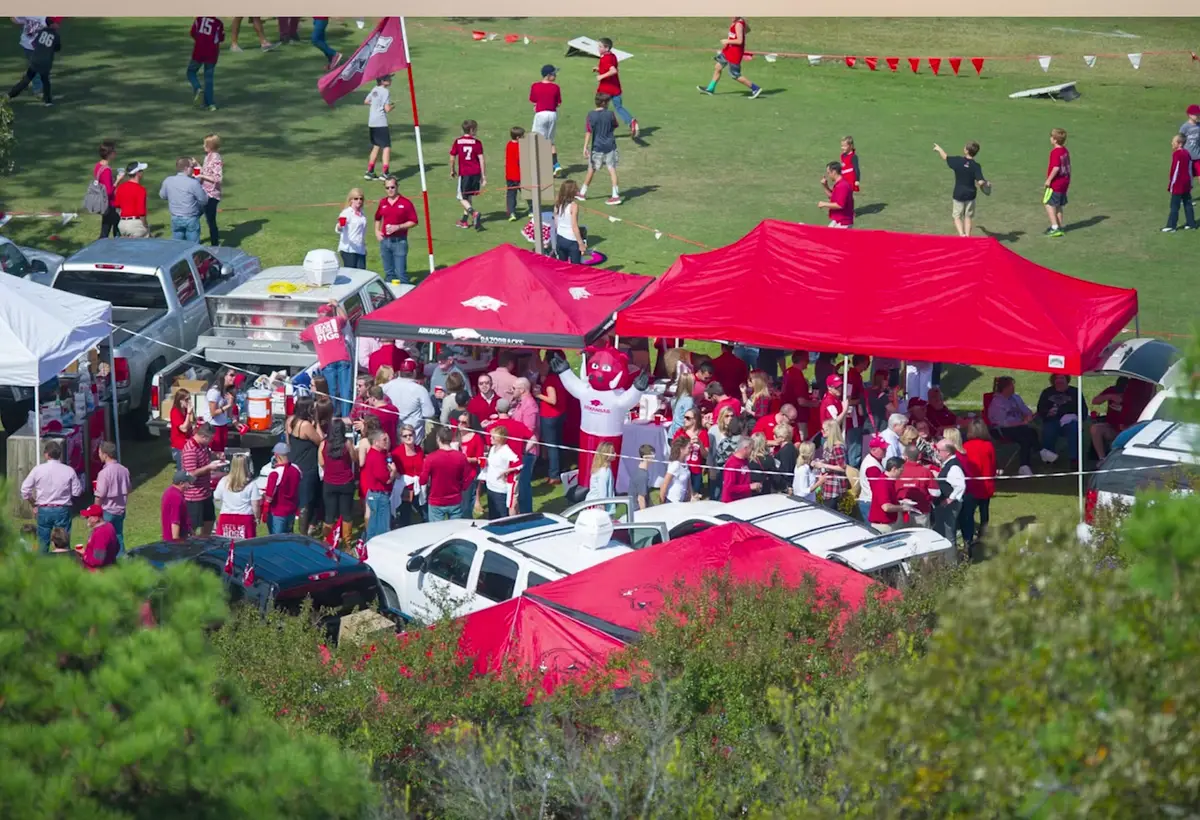
I lowballed a Razorback crowd by twenty to thirty thousand people. In this video I described a home football Saturday in Fayetteville as "when 40 to 50,000 people descend on a city."
Donald W. Reynolds Razorback Stadium seats 76,212. In the 2025 season every home game drew more than 61,000, and the average was 69,762.
And that was a 2-10 season. Those are the numbers in a bad year.
This is the opposite of my usual direction — I tend to round things up, and here I rounded down. If anything the traffic warning I gave was too mild.
A note on the whole video before I go further. I opened by saying "these are going to be my opinions moving from Chicago land area," and that framing is fair — a lot of this is one transplant's impression of a place, which is what people ask me for. The corrections below are the parts where I put numbers on impressions.
One related fix. I said "there's no professional team here" to explain why Razorback fandom fills the whole space. The Northwest Arkansas Naturals are a professional team — a Double-A affiliate of the Kansas City Royals, playing in the Texas League at Arvest Ballpark in Springdale. And Ozark United FC, a professional soccer club, is in development in Rogers with a 5,000-plus seat stadium planned, though it pushed its launch to 2028.
What I meant, and should have said, is that there's no major-league franchise — no NFL, MLB, NBA, NHL or MLS team in the state. That's true and it does explain the Razorback thing. It just isn't the same as no professional team.
The humidity claim is backwards
This is the correction that matters most, because I stated it with specific numbers and it runs the wrong way.
I said "our humidity sits around like in the summertime like around 70%. Illinois honestly sat between like 90 to 95% all the time so it's way more humid up in Illinois."
Northwest Arkansas summers are more humid than Chicago's.
Here's the trap I fell into, and it's worth understanding because it catches a lot of people. Relative humidity gets reported two ways: a pre-dawn maximum, usually the highest reading of the day, and an afternoon minimum. The daily average sits between them.
My "around 70%" for here is roughly a daily mean. The "90 to 95%" I remembered for Illinois sounds like a morning maximum — though as the table below shows, it's high even for that, so I was probably running two different measurements together and remembering the number too high.
Like for like, on annual state averages:
- Arkansas: 85% morning, 49% afternoon
- Illinois: 83% morning, 58% afternoon
Arkansas mornings are more humid than Illinois mornings. Illinois is more humid in the afternoon, and across the full year the two are close enough to call a wash. It's summer where the gap opens against us.
Dew point is the honest measure, because it strips out temperature and tracks how the air actually feels. Average July dew point:
- Houston: 72°F
- Northwest Arkansas region: roughly 66 to 68°F — the nearest station with published normals, Fort Smith, reads 68.5°F, and we sit higher and cooler
- Chicago O'Hare: 61.7°F
So our summer air carries roughly five degrees more dew point than Chicago's, and only four to six less than Houston's. On the standard comfort scale, high-60s dew points are in the oppressive range. Chicago's low 60s are merely sticky.
One weather service rates Fayetteville as muggy or worse on about 74% of July days, with a muggy season running mid-May to late September.
The part I had right: I said it "definitely gets a lot drier... definitely drier in the fall time." That's true and it's the actual answer to the question this video asks. Fall here genuinely is less humid than summer — our dew points drop through October. I just framed it as a year-round comparison against the Midwest, which it isn't.
The long fall — I was right, and there's a name for it
I built the whole video on this: "we've actually had leaves on the trees up until like Christmas time... you can expect that there will be leaves on trees all the way up until the beginning of December. We have a lot of oak trees here so they hold on to our leaves forever."
That's a real, documented botanical phenomenon and I identified the right mechanism.
It's called marcescence — the retention of dead leaves on the branch through winter instead of dropping them in autumn. It's specifically documented in oaks and beeches, exactly the trees I named. The abscission layer at the leaf base never fully forms, so the dead leaf stays attached rather than releasing.
Northwest Arkansas is oak-hickory forest, which is why it's so conspicuous here. And it shows up most on young trees and the lower branches of mature ones — which is exactly why it looks universal from a car window.
Leading explanations for why oaks do it: protecting next spring's buds from cold and drying winds, delivering leaf litter as mulch in spring rather than fall on thin soils, and deterring deer from browsing buds through winter.
The one distinction to hold onto, because it's easy to hear this wrong: marcescent leaves are brown, dead and brittle. They are not autumn color. "There are still leaves on the trees in December" is literally true and has a scientific name. Fall color into December does not happen anywhere in Arkansas.
Peak color in the Ozarks is mid-to-late October. Change starts late September to early October and peaks two to three weeks later. By November, peak color has moved to southern and eastern Arkansas — up here we're typically past it.
So "our fall is extended way longer than normal" is half right in a more interesting way than I knew. The color season is normal-length and ends in early November. The leaves hang on for months after, because of a specific trait of the trees we happen to have.
The temperatures
I said fall runs "from let's say mid-October all the way till November... that stretch of like 40 at night sometimes maybe 50 all the way up to like 70s," and on September, "some toasty days... like 80s, but it's starting to get chilly at night, we're going to start to see the 50s."
The September description is fair. The mid-October-through-November one is optimistic on the low end.
The average first freeze in Fayetteville is October 19. So by the second half of October, nights are dipping to freezing, not bottoming out at 40. And the cold season — average daily highs below 55°F — begins around November 26.
That means the beautiful stretch I'm describing is real but shorter than I framed it: roughly late September through the third week of October, with November running colder than "40 at night."
On the winter framing, in another video I said winters "really start at the middle to end of December." They start closer to Thanksgiving. The cold season runs about November 26 to February 25 — genuinely short, about three months, which is the point I was making. It just starts a few weeks earlier than I say.
The fall activities all check out
I listed the apple orchard and "all the corn mazes," and later "the parades and the events and like I said the corn mazes and the pumpkin patches and the apple cider donuts and the farms." All real, and the apple part is more local than I made it sound.
The Arkansas Apple Festival has been held in Lincoln — Washington County, about twenty miles southwest of Fayetteville — on the first weekend of October since 1976, specifically to spotlight the area's apple crop. So apples aren't a generic fall-activity reference here; there's a genuine local orchard history behind it.
Working orchards and farms in the area include McGarrah Farms, Vanzant Fruit Farms, Rivercrest Orchard and Farmland Adventures, between them covering u-pick apples, corn mazes, pumpkin patches and hayrides.
One thing worth knowing if you're planning around this, since I didn't say it: the Tontitown Grape Festival, which people often mention in the same breath as the fall calendar, is actually an August event.
The geography holds up
I referenced "driving south of Fayetteville into the Boston mountains, driving over past Beaver Lake, going to Kessler Mountain, going over to parts of Bentonville, going into Bella Vista."
All correct. The Boston Mountains do run south of Fayetteville — our cities sit on the Springfield Plateau at the northern edge, so driving south takes you into them. Kessler Mountain is in Fayetteville, just south-southwest of downtown, sitting on the boundary between the Ozark Highlands and Boston Mountains ecoregions. Beaver Lake is a White River reservoir east and northeast of the Fayetteville-Springdale-Rogers corridor, so treating it as a separate direction from the Boston Mountains is right.
The comparison I'd adjust
I compared our fall to New York and Colorado and said ours "does 100% compete directly with all those big names out there."
That's an opinion and I'll leave it standing as one. But there's a real distinction worth making that's more useful than adjudicating which is prettier: Colorado's fall display is dominated by aspen, which produces a spectacular but essentially single-species gold. Ours is a mixed hardwood forest — oak, hickory, maple, sweetgum — which gives you a broader range of color at once but less of that uniform blaze.
Different kind of thing, not a better or worse one. That's a more honest pitch than a head-to-head.
What holds up entirely
The core of the video survives. Fall here is long, the temperatures in the good stretch are genuinely excellent, the activities are real and local, and the season is a legitimate reason to like living here.
And the thing I was reaching for with the leaves — that this place stays green-then-brown far longer than the northern cities people move here from — is true, has a name, and is caused by exactly the trees I said it was.
I just needed to stop comparing our daily average humidity to somebody else's morning peak.