The 15% Is Trees, Not Your Budget
Author
Phillip Shepard
Date Published
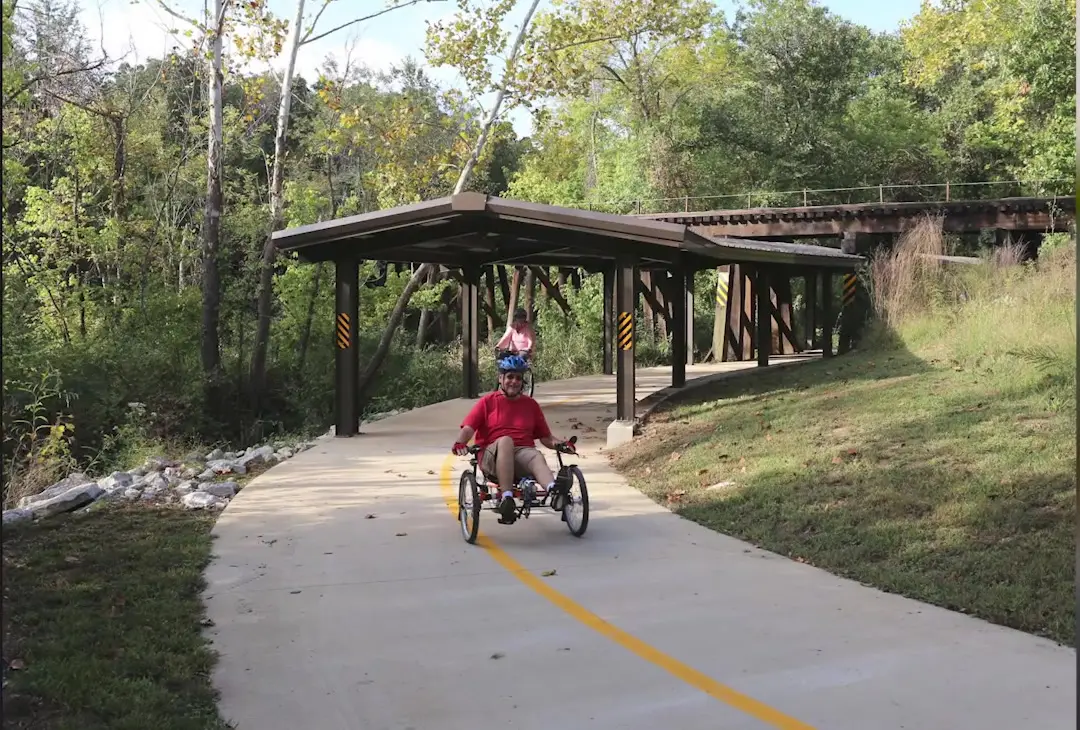
Two Colorado towns beat Fayetteville on the only current list that puts it at #10. This video went out under the title "Fayetteville, Arkansas WINS Top Bike Town in USA!? (Beats Colorado)" — question mark and all — and I opened by saying Fayetteville "just got placed in one of the top 10 most bikable cities in America."
There's a real #10 behind that. But it's six years old, it's not the ranking most people would assume, and the number I built a confident prediction on has since moved the wrong way.
Which ranking, and from when
I said "just got placed." The #10 comes from the 2020 PeopleForBikes City Ratings, where Fayetteville placed tenth in the country out of roughly 550 cities rated — and, better than I mentioned, first in the nation in the Acceleration category, which measures rate of improvement. Fayetteville's climb under that methodology went #45 in 2018, #15 in 2019, #10 in 2020. Genuinely impressive.
That was six years ago, and PeopleForBikes has since rebuilt how it scores. The rated pool went from about 550 cities to 2,579 in 2025 and 3,019 in 2026. The 2020 #10 and any current number are not the same measurement.
Here's where Fayetteville actually sits. In the 2025 ratings: score 51 out of 100, 203rd in the US, first in Arkansas — the first Arkansas city ever to break 50. In the current 2026 ratings: score 49, 425th in the US, and third in Arkansas.
So the score slipped two points and Fayetteville lost the state's top spot. Some of the rank movement is the pool tripling in size, and I want to be fair about that — falling from 203 of 2,579 to 425 of 3,019 is not a collapse. But the national average rose from 30 to 36 over the same stretch while Fayetteville's score went down. The field is improving faster than we are.
And about Colorado. The only list where Fayetteville sits at #10 today is Outside magazine's 2024 "10 Best Bike Towns in the U.S." — restricted to towns under 100,000 people. Fayetteville is tenth on it. Crested Butte is first and Aspen is fourth. So the one current ranking that backs up a #10 also has two Colorado towns finishing ahead of us. Whatever the headline was reaching for, the list underneath it doesn't get there.
The 15% is real — it's trees, not money
This was the most specific claim in the video: "If you're building a commercial space in Fayetteville Arkansas, 15% of your total budget has to go to outdoor spaces," covering "trees and mulch of course, basic stuff, but biking — like actual bike racks connected to the trail systems."
There is no percentage-of-construction-budget requirement anywhere in Fayetteville's development code. What exists is a minimum tree canopy coverage requirement — a percentage of the site, not of the money — set by zoning district in the city's Tree Preservation and Protection code.
And 15% is exactly right for commercial. The minimum canopy is 15% in C-2 Thoroughfare Commercial, C-3 Central Business, Urban Thoroughfare, and both industrial districts. It's 20% in the neighborhood-scale commercial and services districts, 10% downtown, 25% institutional and single-family residential, and 30% in the hillside overlay.
So I had the right number attached to the wrong thing. The two aren't comparable: covering 15% of a site in tree canopy and spending 15% of a construction budget are wildly different obligations, and anyone who heard my version would have badly misjudged what the rule actually asks for.
It also only covers trees. Not mulch, not bike racks. Fayetteville does separately require bicycle parking — there's a whole section of the code titled "Bicycle Parking Areas Required" — but it's its own rule with its own ratios, not part of the 15%. There are also parking-lot tree requirements that kick in at five or more spaces.
My explanation for why the city looks old, though, holds up. I said the mature trees and pathways are why Fayetteville "looks like a very old town." A canopy minimum on every commercial site, enforced across decades, is precisely how you get that. Right conclusion, wrong mechanism.
The grants claim — one part I can't support
I said Fayetteville has, "I think, one of the highest per capita people to businesses in America" that are bike-friendly, "which allowed them to get access to a whole bunch of grants."
The first half is better than I said, and I hedged it more than I needed to. These are Bicycle Friendly Businesses, a designation from the League of American Bicyclists — a national program, not a city one, open to any business with two or more employees. Fayetteville had 30 and ranked 6th nationally in 2021, 50 and ranked 3rd in 2023, and now has 52, ranking second in the country. In one national cohort in spring 2023, 13 of the 48 businesses certified were in Fayetteville — 27% of the entire country's batch.
I described it as "install some biking racks and you become a bike certified business." It's a scored application against five criteria with Bronze through Platinum levels, so racks alone won't do it. But the density claim is real — I said "I think" when I could have said it flat.
And one grant example I reused here that I've since corrected. I said Fayetteville "were able to get some government grants to basically pay for all the new lighting in Fayetteville so that it shines down." Two things wrong with that. The shielded-lighting ordinance is decades old — it predates Arkansas's 2005 Shielded Outdoor Lighting Act and reportedly served as a model for it — so the dark skies aren't a recent grant purchase. And the LED streetlight pilot with Ozarks Electric ran about $127,000 with a grant covering roughly 80%. Subsidized, not free.
The grants half of the bike-business claim I can't support either. The League's published benefits for a certified business are a certificate, a press announcement, a listing, feedback and technical assistance. No funding and no grant eligibility flows from the designation. None of the money that actually built the trail network here references it. I connected two true things — Fayetteville has lots of bike-friendly businesses, and Fayetteville is good at getting grants — with a causal arrow that isn't there.
Who actually paid for the trails
Talking about how the city gets things built, I ran together "government grants," "the Razorbacks, the college," mountain bike competitions, and "a lot of the money from the Northwest Arkansas Council."
The university and the race scene belong in a story about bike culture here, not in a story about who paid for the trails. And the Council's role was coordination and advocacy — it doesn't appear on any funding line.
Here's the real ledger for the 40-mile Razorback Regional Greenway, dedicated May 2, 2015:
- Walton Family Foundation, 2009: $15 million, contingent on matching funds
- Federal TIGER II grant, November 2010: $15 million, awarded to the Northwest Arkansas Regional Planning Commission
- Arkansas State Highway Commission: $855,000
- Partner cities: roughly $8 million more
The two biggest lines are $15 million each, philanthropic and federal, matched against one another — federal money worked out to roughly 40% of the roughly $39 million total. My "government grants" line was pointing at something real and substantial. I just didn't know how big it was.
The local answer is bonds, and it's the part I skipped. In April 2019 Fayetteville voters approved all ten ballot items totaling $226.07 million, funded by continuing the existing one-cent sales tax rather than raising it — including $6.9 million specifically for trails, plus $73.93M for streets and $31.69M for the Cultural Arts Corridor.
I said the bonds funded "the brand new library, the new parks." Parks yes. The library was a separate measure, not part of the 2019 bond.
And there's a newer chapter I filmed too early to include: in March 2026, voters approved all nine items in another bond referendum, about $375.5 million, again on the continued one-cent tax, covering transportation, parks and pedestrian infrastructure. The aquatic center item passed by 210 votes. That's the live trail-funding story now.
One thing to keep straight: the $3.53 million the Walton Family Foundation put up in August 2025 for Greenway bridges is Bentonville's, not Fayetteville's. It rebuilds the segment severed when April 2022 flooding destroyed the Red Iron Bridge over Little Sugar Creek, restoring the Bella Vista–Bentonville link. Completion is expected October 2026.
The 2040 plan is the wrong document
I said Fayetteville "has been crystal clear since 2019 — they issued their 2040 plan," and listed planned connections: under I-49, the west side, Farmington, more trails at Lake Fayetteville, and possibly Elkins.
City Plan 2040 is the comprehensive plan and it was adopted in early 2020, not 2019. More to the point, it's not the trail plan. The trail plan is a separate document — the Active Transportation Plan, which traces back to a 2003 predecessor, was adopted in its modern form in April 2015, and was updated and adopted February 21, 2023. That's the document that maps trails.
It's a good plan and its headline goal is worth quoting properly: a paved trail connection within a 10-minute walk of every residence by 2040, alongside a target of zero fatalities or severe injuries among vulnerable road users by 2030. The network stands at 121.3 miles at the end of 2025 — 61.14 paved and 60.16 natural surface.
On my specific list: I could not find Farmington or Elkins connections in the adopted plan. The only "Farmington" in the document is a creek name on a base map. I want to be careful here — I was able to read the 2015 plan in full but not the 2023 update in the same way, so the honest statement is "not found in the plan I could read," not "doesn't exist." Either way I shouldn't have asserted them.
The I-49 undercrossing I also couldn't verify for Fayetteville. The plan discusses grade-separated crossings as generally preferable at major arterials, but names no specific I-49 project. There is a well-known I-49 trail undercrossing — on Bentonville's Arkansas Missouri Trail. I may have imported it.
"That is for sure"
I predicted Fayetteville would "continue to climb the rankings from 10 at the moment to 8 to 7 to 6, and eventually they'll probably land in the top five at minimum in the next 3 to 4 years. That is for sure."
It was never at 10 in a current national ranking — that was the 2020 number under a retired methodology. And the trend since has been flat to slightly down while the field improved.
Fayetteville's weakest 2026 subscores are the hard ones: Core Services 36 — bike access to schools, hospitals and groceries — and Transit 43. Its strengths are Retail at 69 and Recreation at 53. That's the profile of a place that's excellent for riding for fun and mediocre for riding to get somewhere, and closing that gap takes protected lanes and intersection work, not more trail miles.
Top five nationally in three to four years isn't a realistic target. "That is for sure" was the wrong phrase for a prediction resting on a six-year-old number.
What genuinely holds up
Strip out the ranking and the mechanism errors and there's still a strong case, resting on things I can verify:
- Gold-level Bicycle Friendly Community from the League of American Bicyclists, designation running 2022–2026 — still the only Gold-level community in Arkansas
- Second in the nation for Bicycle Friendly Businesses, with 52
- 121 miles of trail in one city
- A 40-mile regional greenway connecting six cities
- Northwest Arkansas is the country's first Regional Ride Center designated by IMBA, with Bentonville and Fayetteville each holding their own Ride Center status (I've seen tier levels reported for these but couldn't confirm them at the source, so I'll leave the levels off)
The student point holds too. I said a lot of University of Arkansas students ride, that many arrive without cars, and that it takes pressure off traffic. That's a real dynamic, and campus-to-Dickson-Street on a bike is genuinely how a lot of people move here.
The one thing I'd take back on tone
I said "there's really no separate agendas in general — everyone from the parks, from the mayor, from judicial to everyone else involved in Fayetteville movement, it is a top priority to continue to have Fayetteville be an amazing bikable city."
I say a version of this a lot, and it's the part of my commentary I've had to walk back most often. Fayetteville's growth and development decisions are contested — rezonings get fought, council votes come down 4-3, neighbors organize. On trails specifically the consensus really is unusually broad, and two bond elections passing every item is decent evidence for that.
But "no separate agendas" isn't how a city with real disagreements works, and describing it that way flattens the people who show up to the meetings and lose. The accurate version is narrower and still flattering: trails are one of the few things here that nearly everyone votes for.