Bentonville Isn't Spending $63 Million on That Park
Author
Phillip Shepard
Date Published
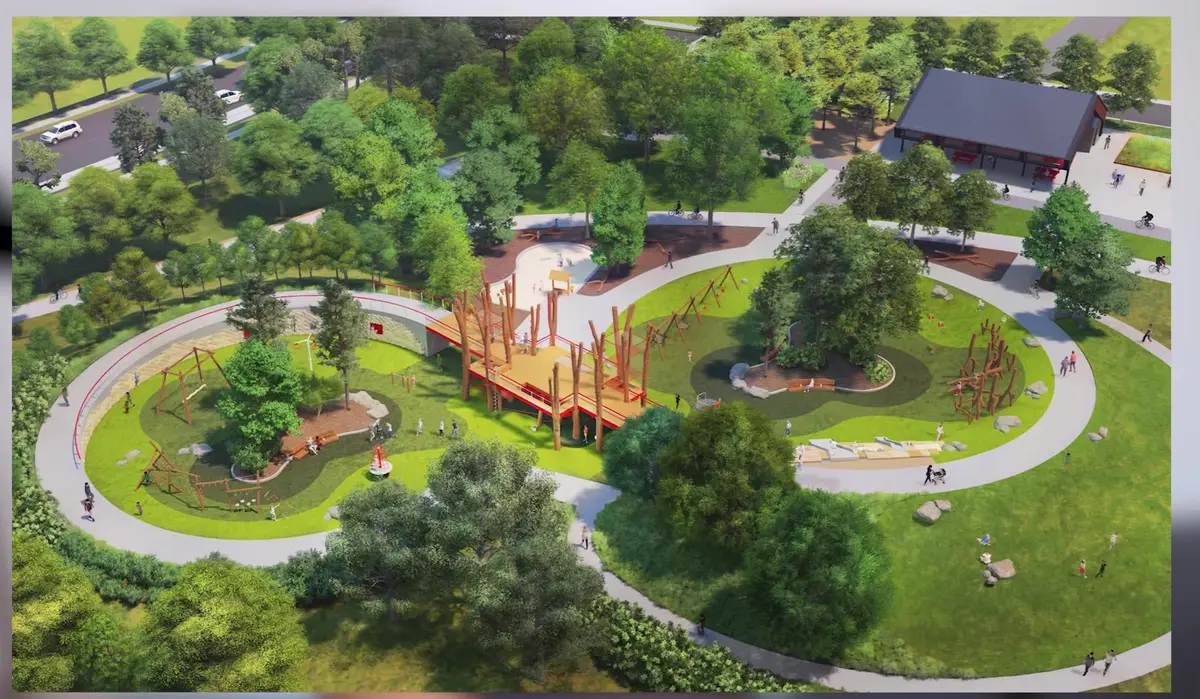
Bentonville isn't spending $63 million on the 8th Street park. I said "the city of Bentonville has budgeted over $63 million for this new Gateway Park slash 8th Street Park," and used it to make a point about how much this city is willing to put into public space.
The project is about $39.35 million, and the Walton Family Foundation is covering up to $32.5 million of it. The city's own share is closer to $7 million.
That's a much smaller number than I gave, and it changes the argument. I was crediting the city with an extraordinary spending commitment. The extraordinary part is philanthropic.
What the park actually is
The official name is 8th Street Gateway Park — I called it "Gateway Park slash 8th Street Park" and noted the city had been going back and forth on naming, which is fair enough.
The acreage I had right, hedge and all. I said "well over 100 acres or close to it," which is about as precise as the public figures are. Most sources say 110 acres; the city's own page says nearly 100 acres of greenspace, and the donated parcels add to 98. So the range in my sentence brackets the range in the sources.
And the land was donated — 75 acres from Walmart in December 2019 and 23 acres from the Walton family. That's worth knowing alongside the funding, because it means the public cost of this park is low across the board.
On status, I'm out of date. I said "they're starting to bid out." The council accepted the $32.5 million grant and approved the roughly $38 million construction contract on August 13, 2024, and construction began that September and October. So by the time I was describing a bidding process, shovels were about to move.
The completion window I gave holds up. In another video I said it wouldn't be fully done until 2026, maybe 2027. Construction was scoped at 24 months from an October 2024 start, with opening anticipated in 2026. That hedge was right.
What's actually being built is more specific than the list I rattled off:
- A regional-destination skate park and "Wheeled Sports Garden", designed by California Skateparks — the firm behind the Paris 2024 Olympic skate park
- An asphalt pump track
- 6 miles of beginner mountain bike trails and 5.75 miles of paved greenway
- A 1-acre signature playground, a 3-acre Great Lawn, a quarter-mile soft-surface running track
- A shade pavilion, comfort stations, and 8th Street overpasses
One detail worth knowing that I didn't mention: the food component is a 13,000-square-foot flexible plaza built for food trucks and special events, not permanent vendors or leased storefronts.
And the trail name I fumbled. I said it would "cross over roads into Apple— I think it's Appleberry." It's the Applegate Trail, sometimes called the Applegate Greenway. It runs north from the park along a creek, through two tunnels, past the Bike Fest grounds and into Coler.
Which is exactly the mechanism I described — I said the park would "eventually go right into Coler Mountain" via "one of the trail systems that connect right directly into Coler Mountain," and that's right. Worth adding the geography: the park sits where a north-south corridor from Coler down toward Osage Park crosses the east-west 8th Street corridor running to the Walmart Home Office, 8th Street Market and the Momentary. It's a trail junction, which is a better thing to be than merely adjacent.
Luther George Park is already open
I said it "is coming to completion in downtown Springdale."
It reopened in October 2024, after about a two-year rebuild. A $12.5 million renovation of 14 acres, designed by Trahan Architects — billed as the largest downtown open green space in Northwest Arkansas.
So it wasn't coming to completion. It was finished.
The Design Excellence Program — I had this right
This was the most specific claim in the segment and it holds up well.
It's the Northwest Arkansas Design Excellence Program, established by the Walton Family Foundation in 2015. My description of what it does was accurate: it pays for the design phase, letting cities and nonprofits hire top-tier architects for public buildings and spaces in Benton and Washington counties.
The numbers are striking. As of December 2024 it had put $28 million into designing 20 projects, which went on to attract roughly $141 million in other public and private construction money. So "they spend a lot of extra money on architects" is right, and the leverage is the interesting part.
On my list of recipients: Thaden School, Luther George Park and TheatreSquared all check out. So do Railyard Park in Rogers, and 8th Street Gateway Park itself, plus A Street Promenade, Dave Peel Park and the Quilt of Parks in Bentonville.
The one to adjust is the Walton Arts Center — which I hedged with "I think," correctly. The Walton Arts Center building itself isn't a Design Excellence project. What is: the Fayetteville Cultural Arts Corridor, which got a $1.77 million design grant for a 12-acre corridor connecting the Walton Arts Center, TheatreSquared, the Community Creative Center and the public library. So I was pointing at the right place with the wrong name.
The brewing center — right instinct, better facts
I said "the University of Arkansas has developed its own branch of itself called the Center of Brewing Innovation," and I spent most of the segment joking about it. Fair enough — I said "I find this mostly funny," and I'm not going to fact-check my own jokes.
But I also said it has "legitimacy to it," and that part deserves better facts than I gave.
The name has changed. It was announced as the Center for Brewing Innovation in August 2024, led by Dr. Scott Lafontaine. It now operates as the Center for Beverage Innovation, housed in the University of Arkansas System Division of Agriculture — so "its own branch of itself" is loosely fair but imprecise.
It's a real research facility: a federally and state-licensed pilot brewery and winery, a 15-gallon all-electric four-vessel nanobrewery, and analytical labs with mass spectrometry and sensory testing.
The rice connection is my best detail and I undersold it. I said Arkansas is "a huge producer of rice and a lot of other material that goes back into beer." Rice malting is a flagship research line — they've screened more than 200 rice lines for malting potential. Published work shows rice improves non-alcoholic beer, making it taste closer to full-strength while cutting fermentation time. The USDA has covered it.
The berries are the part I got wrong. I said they're "doing experiments... using berries, etc." The center's stated focus areas are non-alcoholic beer, grain malting and starch quality, flavor chemistry, sensory science, and pilot-scale brewing. It's grains — specifically rice — not fruit. There is a licensed pilot winery, which might be where I got the idea.
Swapping berries for rice makes the point better anyway: the research is about turning Arkansas's actual biggest crop into a brewing input.
Downtown Springdale — I was right about more than I expected
Onyx Coffee. I said "Onyx Coffee is going on there," and I was right — though it's since opened. Onyx Coffee Lab opened a downtown Springdale location in the historic former First Security Bank building at 112 W. Emma Ave: a three-story, chocolate-focused café that's also the headquarters for Terroir by Onyx, its bean-to-bar chocolate brand, with an open cacao production facility. About a $3 million renovation. That's separate from and in addition to the Rogers headquarters.
The "food housing warehouse." I fumbled the words but had the thing right. It's the Market Center of the Ozarks, a $31 million Walton-backed food hub at 821 E. Emma Ave. that opened in mid-2025. It aggregates and distributes local food so institutions like schools and hospitals can source from regional farmers. A warehouse-format food facility — a food hub, not a food hall.
The steakhouses I mentioned, I couldn't find. What's actually coming downtown: Via Emma, a $34.3 million, 122,000-square-foot mixed-use block with 150-plus residences and six commercial spaces, finishing in summer 2026; Hotel Sundry, a $28 million, 124-room Hilton-branded hotel with a ground-floor Italian restaurant, opening early 2027; and AQ Chicken House reopening on West Emma in spring 2026.
The river walkway and the streets I also couldn't verify. There's a Downtown Springdale master plan and Luther George's design is creek-side, so I may be describing something real, but I can't point at a specific project. Treat those as my impressions.
The parks-planning argument, with the part I leave out
I made a broader argument I believe and still believe: that these cities "have allocated land, bought land, made sure it stayed vacant" for amenities, and that "if there's housing everywhere it's hard to rip down houses and put parks there — it's almost impossible. So it's better to establish it right away."
The land-banking logic is genuinely sound, and 8th Street Gateway Park is a good example of it — nearly 100 acres held out of development inside a fast-growing city.
Here's my caveat to myself. I keep making this argument about parks and trails and hospitals, and I keep not mentioning housing. The region's own Groundwork initiative reports that the typical resident here spends nearly half their income on housing and transportation — among the highest of comparable high-growth regions.
So the honest version is narrower than the one I gave: Northwest Arkansas has planned unusually well for public space and unusually poorly for what it costs to live next to it. Both are true. I tend to only say the first.
And on this particular park, the point I was making — "the interesting thing is how much money Bentonville is willing to spend on these parks" — needs the correction from the top of this post. Bentonville is putting in around $7 million. A foundation is putting in $32.5 million and two donors gave the land. That's a remarkable thing about this region, but it's a different remarkable thing than municipal willingness to spend.