Very Little Arkansas Rice Goes to Japan
Author
Phillip Shepard
Date Published
Very little Arkansas rice goes to Japan. This whole video is built on the idea that a Japanese minister came to Bentonville because Japan wants to buy Arkansas rice — "it will not be far-fetched to see Japan [and] Northwest Arkansas selling rice here in the very near future" — and the trade data makes that a longer shot than I made it sound.
The visit was real. The rice shortage was real. The Arkansas connection is the part I assumed rather than checked.
The rice, and the export figure I didn't know
I opened with an agriculture lesson: "Arkansas actually produces more than 50% of America's rice."
Close. Reporting on this visit puts Arkansas at nearly half the US crop — so "more than 50%" is a bit high, but Arkansas is unambiguously the leading US rice state and the shape of the claim is right. I'd say "close to half" rather than "more than 50%."
I also said it's grown "in the far southeastern part of Arkansas." Arkansas rice country is the eastern Delta and the Grand Prairie, which runs more east and east-central than far southeast — so my mental map is pointed roughly the right way but sits too far south.
Japan's rice crisis was real. The country went through a genuine rice shortage and price spike, and US-Japan rice trade became a live policy issue.
Here's the problem for my argument. The US exported roughly $414 million in rice to Japan in 2023 — and very little of it came from Arkansas, despite Arkansas growing close to half the domestic crop.
To be fair to what I actually said: I framed this as a prediction, not a present fact — "they're reaching out to America and specific parts of America to start importing rice," and my conclusion was that it "will not be far-fetched to see" Arkansas rice going to Japan soon. I wasn't claiming a trade relationship already existed.
But the export number changes how far-fetched that is. Japan is already buying substantial American rice and mostly not buying it from the state that grows half the crop. That's either a big opening or a sign of something structural in the way, and I treated it as a foregone conclusion without knowing which.
Who actually visited, and what his title was
I framed the video around "one of Japan's state ministers hanging out and visiting Bentonville Arkansas quite often."
The official was Norikazu Suzuki, and "state minister" is the right title — I used it correctly here. Worth spelling out what it means, though, since I didn't: in the Japanese system a state minister is a vice-ministerial post, not a cabinet minister. He did become Japan's full Minister of Agriculture, Forestry and Fisheries, but not until October 2025, well after this trip.
(In a different video I described him as "one of the actual political ministers," which does blur that distinction. Correcting that one separately.)
The visit was reported August 30, 2024.
On "quite often" — I framed the whole video around repeat visits. I only have a source for one. If there were others I can't document them, and I shouldn't have built a headline on a frequency I couldn't support.
What I got right: I said I was quoting reporting, and I was. The published account has him saying, through an interpreter, that the team chose Northwest Arkansas for its growth trajectory and potential business opportunities between his ministry and the state. That's essentially what I read out.
The Waltons weren't part of it
I said: "the Waltons met with them, of course. Now obviously nothing was talked about, no deals were made, but Tom Walton, Steuart Walton, they were quoted in the article basically saying that they were very excited to have him here."
No reporting supports any of that. The Waltons don't appear in the coverage of this visit, and I can't find the quotes I attributed to Tom and Steuart Walton. I said they "were quoted in the article" — that's a specific claim about a specific piece of reporting, and it isn't there.
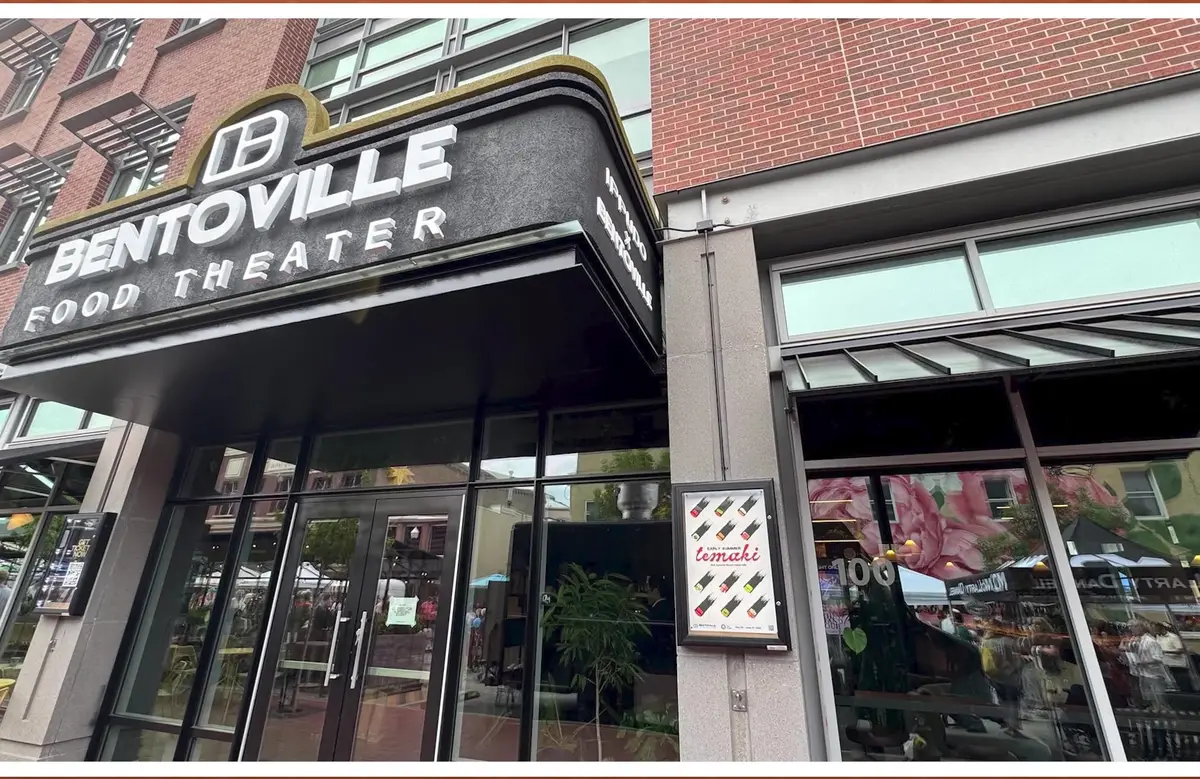
Who actually hosted him: Phil Libin — whose name I fumbled on camera — and Hitoshi Hokamura, both of All Turtles. Libin is the co-founder of the virtual restaurant Bentoville and CEO of All Turtles, and yes, he is the former CEO of Evernote, which I had right.
I do want to credit myself for one thing: I explicitly said "nothing was talked about, no deals were made." That hedge was correct and it's the right instinct. I just wrapped it around a meeting I have no evidence occurred.
The mountain biking, and the detail I missed
I said "the Japanese state minister is also a large mountain biker."
What's actually reported is more interesting than that: he expressed interest in copying Bentonville's mountain-biking model to revitalize rural Japan. That's not a hobby note — it's a foreign agriculture official studying a small American city's trail economy as a rural development template.
Saying he's a mountain biker isn't wrong — it just buries the part that makes the visit make sense.
It also answers the question I posed and left hanging. I asked, more than once, "why do they come to Bentonville? Why, why, why Bentonville? Why don't you go down over there?" — and the answer is right there. He didn't come to look at rice fields. He came to look at how a rural place rebuilt its economy. The rice is grown two hundred miles away; the thing worth studying is here.
The sushi quote — withdrawn
I said: "they sampled it, they said — as the Japanese person said — it's some of the best sushi that he's had even in comparison to Japan."
I can't source that quote anywhere. Not in the reporting on the visit, not in any outlet.
There's also a mix-up underneath it. Libin's restaurant, Bentoville, is a bento concept — I described it correctly as "a Japanese bento style box restaurant." But sushi praise points at a different business entirely: Junto, the Japanese restaurant in the Motto by Hilton downtown — a separate business, run by the Indigo Road Hospitality Group, with a menu curated by chef Masa Hamaya. In another video I attached the same unsourced sushi quote to that restaurant.
So I have one quote I can't source, applied to two different businesses, in two different videos. I'd withdraw it in both places. Both restaurants may be excellent — I have no reason to think otherwise — but nobody should pick one because I said a foreign official blessed it.
One line I'd cut. I said "I'm a big fan of Phil because, well, we all know why Phil." That went unexplained, nobody watching knows what it refers to, and a knowing aside about a named person with nothing behind it isn't something I should put on camera. I'd just say I like what he's building and leave it there.
The lithium aside
I mentioned, and flagged as off-topic, that "in the far southern side of Arkansas we might have the biggest lithium deposit in the world."
There is a real and significant lithium story in south Arkansas — the Smackover Formation brine resource. Whether it's "the biggest in the world" is a much stronger claim than a large domestic resource, and I didn't verify it here. I hedged it with "we might," which helps. I'd leave the superlative off until I can check it.
What holds up
The closing observation is the best thing in the video, and it survives everything above: "it is interesting to see Japan not go to Little Rock, not go to the southeastern part of Arkansas — they came here."
That's genuinely worth noticing. A foreign agriculture official skipped both the state capital and the rice-growing region and spent his time in a metro of 620,000 people in the far northwest corner. The reason isn't rice logistics. It's that Northwest Arkansas has become a place people travel to in order to study how it was built — which is a better and more surprising story than the trade-deal one I told.