A Warning About Mortgage Rates — Scored Against What Actually Happened
Author
Phillip Shepard
Date Published
A Warning About Mortgage Rates — Scored Against What Actually Happened
I made a rate prediction in early 2025 and told you that buying now beat waiting. Nineteen months later I can check both, and I want to do that here, in public, rather than let it fade.
I am a real estate agent. I said so in the original video, and I will say it again here, because everything below is a claim that pays me when you act on it. That is the reason to check it, not a reason to dismiss it — but check it.
The prediction, scored
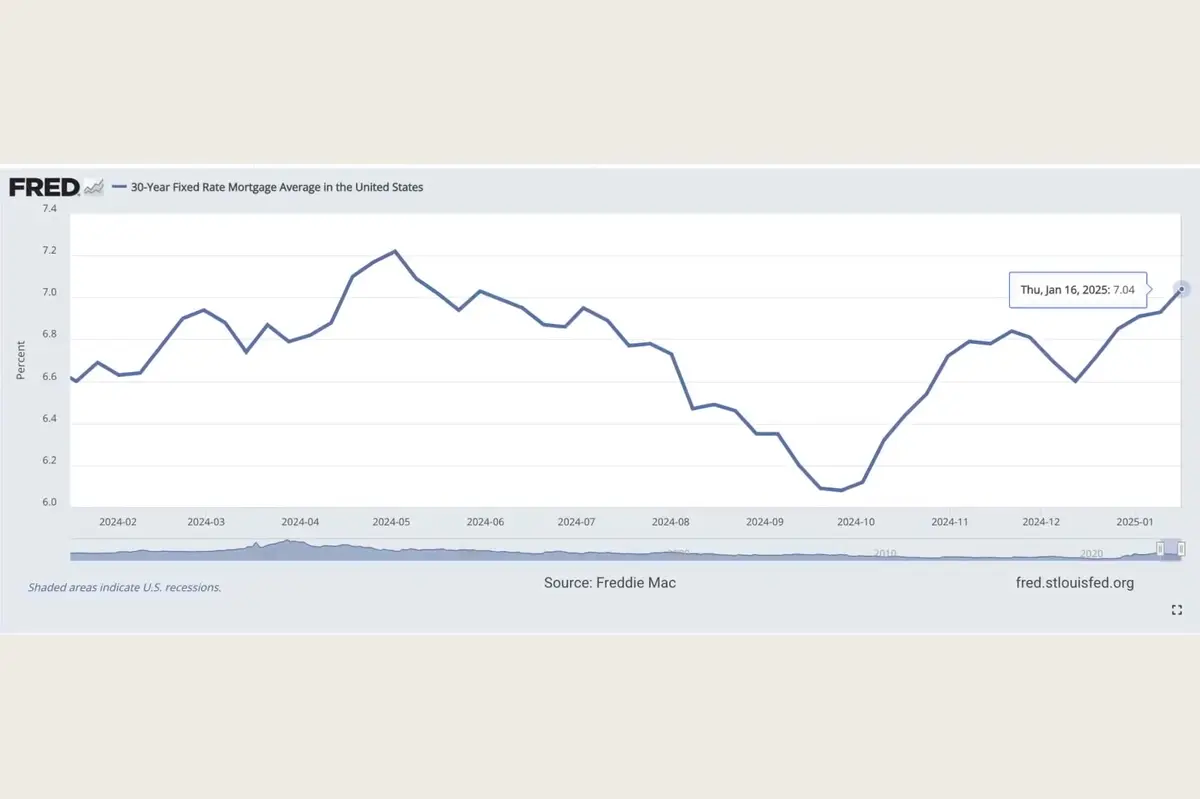
I said rates were "sitting right around the seven mark" and that they "should be starting to get pushed on to six and hopefully get into the fives sometime in the next year or less."
Here is what the Freddie Mac survey actually recorded for the 30-year fixed:
- January 2025: 6.96% — my "around seven" was accurate
- September 2025: 6.35%
- December 31, 2025: 6.15% — the low of the year
- August 2026: 6.65%
In fairness to the original, I hedged this harder than the headline suggests. I also said I did not know whether it would take "2 years, 5 years, 7 years," and called the whole thing to be determined. That does not undo the urgency in the rest of the video, but it belongs in the record.
So: half right, then reversed. Rates did get "pushed on to six" — that part happened. They never reached the fives, at any point, in nineteen months. And by mid-2026 they climbed back to within about 30 basis points of where they started.
If you took "hopefully into the fives in the next year or less" as a plan and waited, you are still waiting. If you assumed December 2025 was a floor, it was not.
One mechanism I should have explained better. I framed this around the Fed and Jerome Powell. The Fed did cut three times in 2025, moving the target range from 4.25-4.50% down to 3.50-3.75%, then held through 2026. Mortgage rates fell only partway and then rose anyway.
That is because the Fed does not set mortgage rates. Thirty-year fixed rates track the 10-year Treasury yield, not the overnight federal funds rate. Federal Reserve research puts mortgage rates at roughly 85 percent responsiveness to 10-year Treasury moves and under 20 percent to fed funds moves, with a typical spread of 1.5 to 2 points. That is why you can watch the Fed cut and watch your quoted rate not move.
"Renting is wasting that money" — I should not have said that
I said buying now "is going to be a big win for you versus waiting for 2 years renting wasting that money," and called renting "money left on the table" and "unnecessary."
That framing is industry shorthand, and it does not hold up against the research. Here is why.
Buying has large front-loaded transaction costs. Roughly 2 to 5 percent to buy, and another 6 to 8 percent to sell later. You have to earn that back before ownership beats renting on the numbers.
There is a breakeven horizon, and it is not short. The commonly cited estimate is around six years nationally before a typical buyer comes out ahead of renting, varying with local rent-to-price ratios. Shorter stays generally favor renting.
Most of an early payment is not equity. On a $400,000 loan at 7 percent, the monthly payment is about $2,661. In month one, roughly $2,333 goes to interest and about $328 to principal — 88 percent interest, 12 percent principal. Add property taxes, insurance, PMI if you are under 20 percent down, and maintenance at roughly one percent of home value a year, and the equity-building share of your housing cost in year one is small.
So the honest version: in the first years at 7 percent, buying is also mostly a non-equity expense. Ownership can build real wealth over a long enough hold with appreciation. But "renting is throwing money away" ignores the closing costs, the breakeven period, and the fact that a renter can invest the down payment instead.
I told people renting was wasteful while recommending a product I earn a commission on. Even believing it, that was the wrong sentence.
The buydown-and-refinance plan needs its risk stated
I said you can "take a portion of that down payment, that closing cost, and use it to buy down the rate for about 1 to 2 years and then kind of offset your mortgage cost and then refi after on year three," and called it "very doable."
The mechanics I described are accurate. A 2-1 buydown cuts your effective rate by two points in year one and one point in year two, funded upfront at closing, often by a seller or builder concession. In year three it reverts to the full note rate for the rest of the loan.
What I left out is what happens if rates do not fall.
Under Fannie Mae and Freddie Mac rules, you must be qualified at the full note rate, not the bought-down rate — so on paper you can afford the year-three payment. The danger is a borrower who is only actually comfortable at the temporary payment. The CFPB's guidance is to compare loans with and without the temporary reduction and to underwrite to the note rate.
If rates have not dropped by year three, there is no relief mechanism. No refinance obligation exists. You pay the full note rate indefinitely. And refinancing is not free — closing costs typically run 2 to 6 percent of the loan, which the rate savings have to justify.
And this is not hypothetical anymore. Someone who bought in early 2025 at roughly 7 percent, bought the rate down, and planned to refinance into the fives by 2027 or 2028 does not have that option today. Rates are at 6.65 percent. The strategy's entire benefit rested on a rate move that has not come.
"Very doable" describes the mechanism. It does not describe the outcome, and I presented the two as the same thing.
The competition argument is speculation
I argued that when rates drop, buyers from Georgia, Michigan and California will sell, arrive with equity, and "compete at a higher level," so buying first is an advantage.
The underlying effect is real. FHFA research documents the mortgage rate lock-in effect: every one-point gap between a homeowner's rate and the market rate cuts their odds of selling by about 18 percent. FHFA estimates lock-in reduced home sales by roughly 1.7 million between 2022 and 2024 and pushed prices up about 7 percent.
But my conclusion does not follow from it. That research describes suppressed supply. When rates fall, it unlocks sellers as much as buyers — which adds inventory and could work against prices, not for them. Nothing in the research supports my specific prediction of an out-of-state demand surge into Northwest Arkansas.
That was a plausible-sounding story presented as a forecast. It is neither established nor refuted. It is a guess, and I should have labeled it one.
The infrastructure claim is wrong, and a buyer could act on it
I said builders here fund infrastructure through negotiation with cities, and that there are no "SIDs or any sort of bonds attached to the property that doesn't exist here in Northwest Arkansas in comparison to other parts of America."
That is false as a categorical statement. Arkansas Code Title 14, Subtitle 5 explicitly authorizes improvement districts — municipal improvement districts, property owners' improvement districts, and municipal property owners' improvement districts. These districts can issue bonds and pledge benefit assessments against property as security. That is exactly the structure I said does not exist here.
Arkansas properties can and do carry improvement district assessments. Read your title commitment and your tax bill. Do not skip that line because someone told you it is not a thing in this state.
Where the market actually went
I said Northwest Arkansas was "very resilient" and still building fast. That held up on the construction side — Bentonville's building permits rose about 33 percent in 2025.
But the market has turned in a direction that undercuts my urgency. The H1 2026 Skyline Report from the University of Arkansas describes Northwest Arkansas as a buyer's market. Benton County's average sale price is down 1.2 percent year over year to $465,888. Multifamily vacancy nearly doubled to 7.3 percent.
And on rent versus own, my "very close" claim does not hold up here. Take the Benton County average of $465,888 with 20 percent down. That is a $372,710 loan at today's roughly 6.7 percent — about $2,400 a month in principal and interest alone. Add taxes and insurance, commonly $400 to $600 in Arkansas, and you are at $2,800 to $3,000. Add maintenance at one percent a year and you are at roughly $3,200 to $3,400.
Against that, HUD's fair market rents for this metro are $1,347 for a two-bedroom and $1,873 for a three-bedroom. Those are 40th-percentile figures, so real market rents run higher — but not high enough to close that gap.
Ownership currently carries a real monthly premium over renting in this market. It may still be the right call for you over a long enough horizon. It is not "very close," and I should not have said it was.
What I would tell you now
Buy when your life calls for it and the payment works at the actual note rate — not because a rate forecast said so, and not because someone told you rent is wasted.
If you are staying under five or six years, run the breakeven honestly. If you are using a buydown, ask what your payment is in year three at the full rate and whether you can carry it with no refinance at all. And read the title commitment for assessments.
I got the direction of rates right and the destination wrong, and I attached an urgency to it that the last nineteen months did not justify.