The Dream Hotel Is Not Being Built
Author
Phillip Shepard
Date Published
The Dream Hotel is not being built. In this video I said they were "about to break ground in early 202-" — the year cuts out in my own audio — "for the Dream hotel" at Pinnacle Hills, and that the Ruth's Chris building would be demolished to make room for it.
The project was killed on December 30, 2024. I don't know exactly when I filmed this, so I can't say whether I was reporting stale news or predicting something that had already been called off. Either way, the correction stands and it's the one that matters most here, because I told people to expect a 16-story hotel on a site where nothing is planned.
What happened to the Dream Hotel
Beaty Capital Group of Rogers proposed it in March 2024 with New York-based Dream Hotel Group: 16 stories, 207 rooms on the 1.57-acre Ruth's Chris site at 3529 S. Pinnacle Hills Parkway, plus a 2,200-seat TempleLive venue. Originally north of $150 million.
By August 2024 the entertainment venue was dropped over parking, cutting the cost to around $100 million. Then on December 30, 2024, Hunt Ventures bought the land specifically to stop the hotel from being built. Beaty called it an amicable transaction and noted "some had reservations about the density that we were proposing on that site." Hunt Ventures has no definitive plans for the property.
Ruth's Chris is moving — that part I had right. It's relocating to a new two-story, 20,000-square-foot space at The Plaza at Pinnacle Hills, a $110 million-plus mixed-use development by Great Lakes Capital across from Hotel Vin. But the old building isn't being cleared for a hotel. I fused two separate stories.
Hotel Vin is real, and it's a deliberate brand extension
I said "they just broke ground on Hotel Vin." True — October 2024. It's Hotel Vin Rogers, Autograph Collection, an Autograph Collection by Marriott property developed by Great Lakes Capital with Coury Hospitality. More than $72 million, 125 rooms, over 10,000 square feet of meeting space, a restaurant, rooftop bar and outdoor pool. Opening was announced for spring 2026 and later restated as summer 2026.
Worth knowing: it shares a name with Hotel Vin in Grapevine, Texas because both belong to Coury Hospitality's VIN Hotel Collection, with Grapevine as the flagship. Not a coincidence.
Blue Crane isn't a consulting firm, and the hotel has a name now
I said the Bentonville hotel was "being done by Blue Crane... Blue Crane is owned by Tom and Steuart Walton — they're kind of a consulting building firm located in Bentonville," and that they're "most known for building restaurants and businesses and selling them off to investment people."
The name and ownership are right, including the spelling Steuart. The rest isn't.
Blue Crane is a real estate development and management company, not a consulting firm. It spun off from Ropeswing Hospitality Group in 2018 to focus on real estate; the restaurants stayed with Ropeswing. And I found no evidence it sells projects to investors — its portfolio, including The Preacher's Son, The Pressroom, 8th Street Market, The Record and the Massey Hotel renovation, is held and managed. I'd cut that line entirely.
The hotel is open and it has a name. It's The Compton, at 200 E. Central Avenue on the Bentonville square — 142 rooms, six stories, about 150,000 square feet, opened December 2025 and managed by Practice Hospitality. It's named for Dr. Neil Compton, the Bentonville conservationist who led the campaign that made the Buffalo the country's first National River.
I said "there's very little known about the actual downtown hotel yet. No name." That was true when I filmed and isn't now.
My ground-floor prediction was right — restaurant, bar, café, event space and two retail spaces. On the mountain-biking theme, I was half right: The Compton has bike valet, wash stations and secure storage, but its identity is Ozark conservation broadly. The hotel actually built around cycling culture is the Motto by Hilton in Bentonville, 175 rooms, which opened downtown in August 2024. (Note for later in this post: there's a second, unrelated Motto planned in Fayetteville. Same brand, different city.)
The AC Hotel: I had this one clean
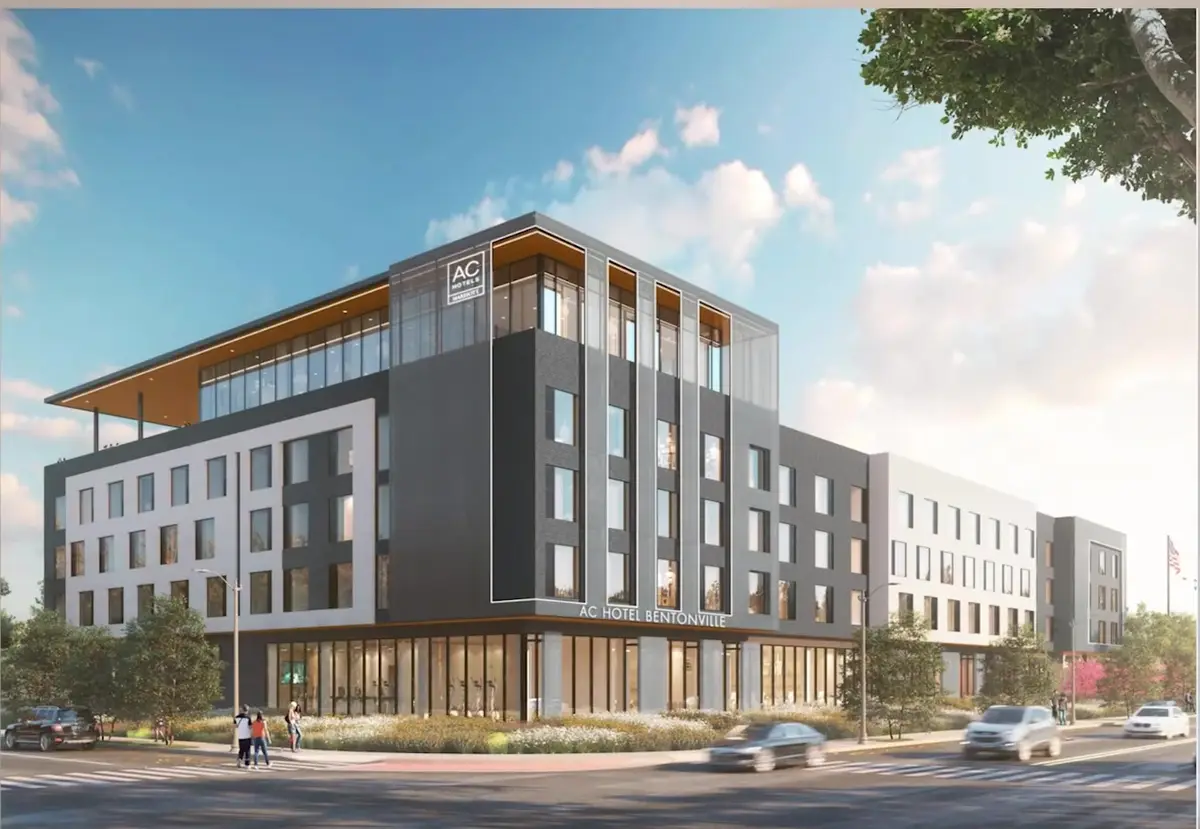
AC Hotel Bentonville at Walmart Campus, an AC Hotel by Marriott, 153 rooms, five stories, roughly 90,000 square feet, with a rooftop lounge called Falfurrias — named for the Texas town Sam Walton retreated to — and more than 9,000 square feet of event space. It opened in May 2025.
My 350-acre figure for the campus is correct; that's Walmart's own number. Associates began moving in during 2024 and Walmart formally opened the campus in January 2025.
One thing I got wrong in the useful direction: I guessed "I don't know if this is going to be public facing. I assume parts of it will be, but there will definitely be an aspect dedicated only for people coming in to visit Walmart." It's open to the public, full stop. If you want to stay on the Walmart campus, you can.
I also attributed a theme of "unparalleled hospitality" to it. I can't source that and it reads like generic brand copy, so I'd drop it.
Markham Hill: the tree claim I should not have made
I said of the Markham Hill hotel that "they were very minimalistic on the environment itself. Really no trees were taken down, honestly."
I can't verify that, and it's the wrong thing to say confidently about a project that drew organized neighborhood opposition specifically over tree loss.
Here's the record. Opposition dates to 2018. A "Save Markham Hill" petition circulated, a group called Friends of Markham Hill formed and still exists, and at a 2019 Planning Commission hearing 13 of the 14 residents who spoke asked the commission to deny the request. A preliminary development plan stalled in December 2019. The objections were habitat and forest loss, the hill's status as a designated Natural Area under the city's plan, tree removal on Cross Avenue, and traffic.
Here's what's actually defensible and, I'd argue, a better story: Specialized Real Estate Group finalized a 39-acre conservation easement with the Northwest Arkansas Land Trust in November 2024. Combined with 13 acres of dedicated parkland, that's more than 50 acres permanently preserved, running with the deed. It adjoins a 62-acre hillside parcel the city bought from the university in 2020.
So a little over 50 acres of the roughly 144 Specialized owns are permanently conserved. That means the majority of the parcel — something like 90 acres — is not under easement, and carries the hotel plus a residential neighborhood. "More than 50 acres are protected forever" is true, verifiable and generous to the developer. "No trees were taken down" is neither.
The hotel itself is The Stonebreaker — one word, not "Stone Breaker." 78 rooms, developed by Specialized Real Estate Group, operated by Hay Creek Hotels, built in and around a Victorian house that absorbed the former Pratt Place Inn. The restaurant and event space opened in 2024 and the hotel in January 2025. I said "heated pools" plural; it's a seasonal outdoor pool and hot tub. The members' club I mentioned is real.
The Ramble and South Yard are two different places
This is the geography error I most want to fix, because I sent people to a place that doesn't exist. I described a "South Ramble, South Yard section" of Fayetteville and then said the Ramble "is truly by the Fayetteville library, and then it goes farther north over by Dickson Street."
There is no South Ramble. These are two unrelated developments about a mile apart:
- South Yard is the mixed-use development in south Fayetteville at Martin Luther King Jr. Boulevard and South School Avenue, by Specialized Real Estate Group.
- The Ramble is the downtown park and civic plaza next to the Walton Arts Center, part of the city's Cultural Arts Corridor. It's a City of Fayetteville project, not a private one.
Moxy Fayetteville — the first Moxy in Arkansas — is at South Yard, at 530 W. Streamside Bend. Seven stories, 131 rooms, $33 million, developed by Specialized with Beechwood Hospitality. Broke ground February 2024, opened September 2025. My description of the character was right: it's a younger, lower-price-point brand where you check in at the bar.
I tied several hotels to "the Ramble." Only one is actually there.
The two Dickson Street hotels: both real, and the train bank detail was exact
The one at The Ramble. Referred to in coverage as the Park Hotel and still unnamed, so "no announcement yet of the actual brand" was accurate. Seven stories, 114 rooms, at the southern end of the civic plaza across from the Walton Arts Center, developed by Brian Reindl of Reindl Properties. The City Council approved a planned zoning district in May 2024 after selling a half-acre of city land for just under $1.25 million in 2023. Ground floor is planned as public-facing space fronting the park — coffee shop, cafe, restaurant, bar, covered patio, and a restroom with outdoor access for park users. Rooftop bar and pool planned.
And yes, that site was formerly a parking lot, exactly as I said.
The train bank site. I said it's "where the actual Fayetteville train bank was" — and that's precisely right. It was a Bank of Fayetteville branch housed in a train car, known locally as the train bank, which closed at the end of September 2024.
What's going there is a dual-branded Motto by Hilton and Tempo by Hilton — a separate Motto from the Bentonville one mentioned earlier — seven stories, 220 to 230 rooms, on 0.7 acres at 542 Dickson Street, the northwest corner of Dickson and West Avenue. Dickson Hotel Depot LLC, led by investor Shash Goyal, paid $4.6 million for the property. Plans include a sports bar, coffee shop and rooftop restaurant.
For scale, Fayetteville had six hotels in the pipeline as of mid-2024: the Stonebreaker, the Moxy, the Park Hotel, a Country Inn & Suites, a Home2 Suites, and a combined Residence Inn and SpringHill Suites.
The short-term rental theory is mine, not the city's
I said Fayetteville's short-term rental cap exists because "to incentivize hotels to actually build in cities, you need to have an agreement to say, hey, we're not going to allow our short-term rentals to get out of control, because we don't want that to make competition for you."
The cap is real. The motive is my theory, and the record points elsewhere.
The ordinance. Fayetteville's council voted unanimously on April 20, 2021. The cap applies only to rentals with no owner living on site; owner-occupied short-term rentals are uncapped. The original limit was 2% of housing units, about 900. In July 2023 the council cut it 6-0 to a hard 475, and the city hit that cap in December 2023.
The stated reasons were housing supply and affordability first — one council member said she knew of affordable homes taken off the market to become short-term rentals — then neighborhood character and safety, then tax collection and a level playing field among homes, illegal rentals and hotels.
That third item is the only hook for my version, and it's about tax parity for existing lodging, not about courting new hotel construction. Two things cut against me harder: housing was the dominant framing throughout, and the 2023 amendment actually removed an exemption that had let short-term rentals operate freely in districts zoned for hotels. That's a tightening driven by density concerns, not a bargain with developers. I also found no evidence that Fayetteville hotels lobbied for the cap.
If I keep the argument, it needs to be labeled as my read rather than the city's rationale.
The premise: a real signal, oversold
My framing was that "if hotels, who are doing way more research than us, are saying this area is going to be economically fine for a long time," you can relax.
There's something to it. Hotel development is capital-intensive and slow, underwritten with third-party feasibility studies, so it does encode professional demand forecasts. And the regional fundamentals are strong — record population, rising incomes, record University of Arkansas enrollment.
More to the point, most of this wave is catch-up. Benton and Washington counties had roughly 6,800 standard hotel rooms — only about 300 more than a decade earlier. A University of Arkansas economist put it plainly: the region invested heavily in tourism and the hotel industry was late to catch up. Experience Fayetteville says it has lost conventions for lack of rooms.
Here's what I left out. The region is now working through the largest delivery cycle in its history — nine new hotels with more than 1,100 rooms opening, and roughly 1,900 additional rooms anticipated by 2028. An analysis published by a commercial real estate brokerage, drawing on CoStar data, indicates supply has now overtaken demand and projects revenue per available room to decline over the coming quarters. Worth noting that a brokerage has its own interest in the market narrative, so weigh it accordingly. Nationally, forecasters see 2026 US occupancy dipping to around 62% with barely half a percent of revenue growth.
And the best argument against my premise is sitting in this very video: the Dream Hotel. A $100 to $150 million, 207-room project, fully announced by experienced developers who had run the numbers — and abandoned. Overbuilding cycles happen precisely because many developers independently reach the same optimistic conclusion at the same time.
So the honest version: hotel construction shows professional investors betting on long-term growth here, backed by real population and income data. It is a lagging correction to twenty years of underbuilding, not a forward guarantee — and the next couple of years look like a period of digesting supply rather than validating it.