4 Wild Things Happening in NWA
Author
Phillip Shepard
Date Published
4 Wild Things Happening in NWA
Two of these went the opposite way from what I expected. One business I was celebrating has closed. One conference I treated as a modest local event turned out to be a bigger deal than I said. And I made a claim about AI reading medical scans that needs real correcting, because it is the kind of thing people repeat.
1. The Motel 6 conversion is real, and it has a name
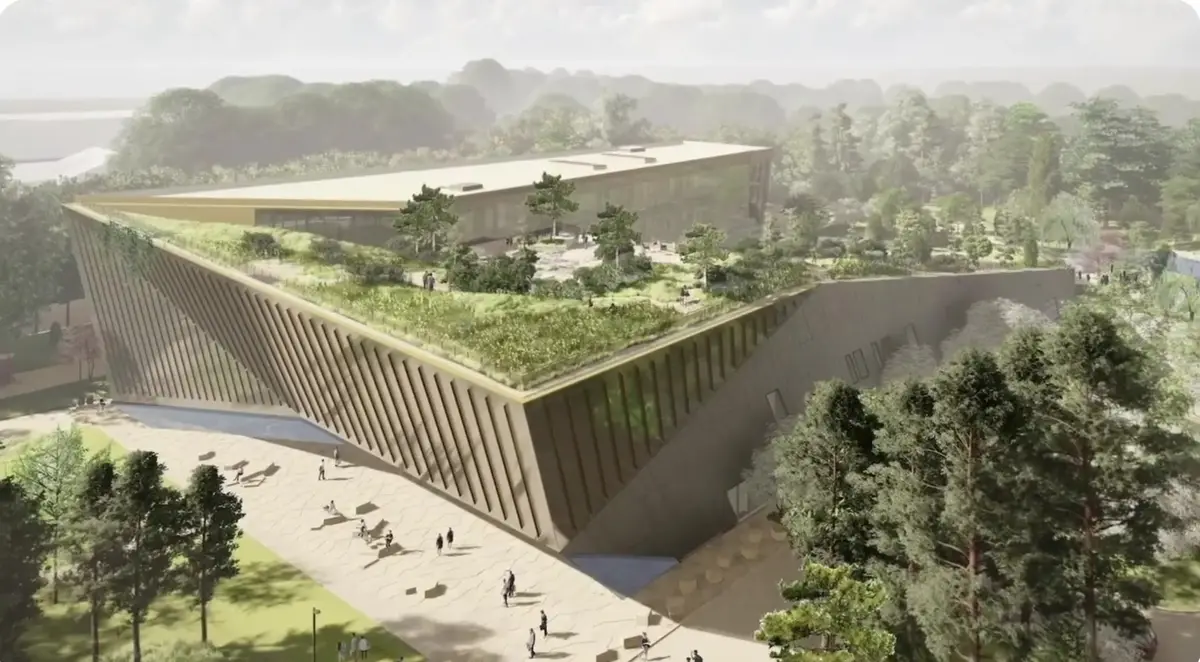
The project is The Overland Hotel Fayetteville, developed by Dwellist — Charlie Mackey and Polly Watts — which bought the former Motel 6 property in 2024 for $4.25 million. It will be an 85-room independent boutique motor lodge, with a coffee shop, cocktail bar and pool courtyard.
One thing I assumed wrong: I talked about older buildings getting "ripped down." This one is not. They are keeping the exterior-entrance motor lodge format and adding a new building along College Avenue. That is a more interesting adaptive reuse than a teardown.
Fayetteville planners approved it in August 2025. As of this month it has not opened yet — still in late-stage development, aiming for a fall window. So if you were planning a Razorback weekend around it, not yet.
The zoning point I gestured at was right and worth naming. In October 2024 the City Council unanimously adopted the **Urban Corridor zoning district** for roughly 600 acres along the 71B corridor. It converted old Commercial Thoroughfare parcels — which did not allow housing at all — into mixed-use zoning that permits apartments, small multiplexes and buildings up to eight stories, and requires buildings to sit near the street rather than behind parking. That is exactly the mechanism I was describing.
2. Casa Magnolia has closed
This is the update I did not want to write. Casa Magnolia closed permanently in October 2025, after roughly eight months.
It opened February 21, 2025 at Holcomb and West Allen in downtown Springdale, in a two-story house — a Yeyo's food truck, a coffee shop, the Two Friends Community Bookstore, and communal art space together. Created by Rafael Rios. The bookstore ran on a pay-what-you-can basis, which is close to the "pay as you go" I described. There was a children's program that traded a book discussion for homemade ice cream.
As of early 2026 the bookstore was reportedly looking for a new downtown Springdale location. I cannot confirm it found one.
Everything I liked about it was real. The affordability argument I made — that downtown Springdale had gotten expensive and this gave people a $3 coffee option — was the whole point of the place, and it lasted eight months anyway. That is worth sitting with rather than glossing.
Now the James Beard record, which I owe Rafael Rios accurately. I said "he has won the — won or at least been nominated," and that he "got nominated for best in America."
Here is the real record. Rios has been a James Beard semifinalist for Best Chef: South in 2020, 2022, 2023, 2024 and 2025. In 2025 he advanced to finalist — a genuine step up, and it made him Arkansas's most-nominated chef. Matthew Cooper of Conifer, also in Bentonville, was a finalist the same year. Rios runs Yeyo's El Alma de México in Bentonville; Casa Magnolia was his Springdale venture.
He has not won. The 2025 Best Chef: South award went to Nando Chang of Itamae AO in Miami. No Arkansas chef has ever won a James Beard Award.
And there is no "best in America" category. The Best Chef awards are regional — South, Midwest, and so on. The ladder is semifinalist, then finalist, then winner. Rios reached the second rung in 2025 and the first rung four other times. That is a real and impressive record, and it does not need upgrading.
3. The urbanism conference — I undersold it
I read the name off the screen and called the attendees "a bunch of city nerds," then guessed they had done "like 30 of them" and usually pick bigger cities.
All correct, and it landed bigger than I suggested. CNU 34 — the 34th Congress for the New Urbanism — was held in Northwest Arkansas May 12 to 16, 2026, the first time in Arkansas. Because the region is spread across multiple cities, it ran as a multi-location event across Bentonville and Fayetteville, drawing more than 1,200 planners, architects, developers and civic leaders.
My "usually bigger cities" read checks out: CNU 33 was Providence, 32 was Cincinnati, 31 was Charlotte. Northwest Arkansas was a deliberate departure from that pattern.
4. The AI claim — this one needs real correcting
I said that over "the last 6 months there's been many, many occurrences where an AI will be able to scan an MRI or a CAT scan or x-ray or something and be able to more accurately tell what is wrong with a person than a doctor will."
That overstates the evidence, in a specific way worth understanding.
What is true: AI tools now match or modestly beat unaided human readers on narrow, well-defined detection tasks — is there a nodule here, is this bone fractured, does this mammogram warrant a second look. That is real, and it has been building since about 2019 rather than emerging in a six-month window.
What is not true is the leap from that to "tell what is wrong with a person." Diagnosis involves history, examination, labs and judgment. AI models are validated against one finding in a curated dataset, not against that whole process.
The actual numbers are less flattering than my version. A large international mammography benchmarking study across 44 countries found AI alone did not outperform radiologists — AI scored 0.87 on AUROC, the standard measure of diagnostic discrimination, against radiologists' 0.96. What did improve on both was AI combined with a human reader. A separate meta-analysis found unaided clinicians at 0.67 sensitivity and 0.82 specificity, against 0.79 and 0.87 for AI-assisted clinicians. The gain comes from pairing, not replacing.
And a landmark review screened roughly 31,587 papers on AI diagnostics and found fewer than one percent were rigorous enough — proper design, external validation — to judge whether AI actually matched human performance on the same task. A great deal of "AI beats doctors" messaging rests on the other 99 percent.
On FDA clearance, which sounds more decisive than it is: there are now more than 1,100 FDA-cleared AI radiology algorithms. But the overwhelming majority come through the 510(k) pathway, which requires showing substantial equivalence to an existing device — similarly safe and effective. It is not a finding of superiority. "The FDA cleared a thousand of these" is true and does not mean what people think it means.
My "predict cancer 5 years before it happens" example is real, and more modest than it sounds. It describes Mirai, developed at MIT by Adam Yala and Regina Barzilay's lab, validated on more than 1.7 million mammograms across the US, Sweden and Taiwan, and shown to outperform the standard Tyrer-Cuzick clinical risk model. But Mirai estimates statistical risk over a future window. It is a risk-stratification tool for deciding how often someone should be screened. It does not detect a cancer that is not there yet.
The honest version of my argument: AI is genuinely changing radiology, the strongest and most consistent finding is that AI plus a doctor beats either alone, and a new medical school with no legacy systems is a real place to test that. That was my actual point and it survives. "More accurately than a doctor" was me putting a thumb on it.
One correction on the institutions. I described the Whole Health Institute as "a knowledge base of medical that they can then sell to other hospitals." Heartland Whole Health Institute is a nonprofit that works through research, advocacy and education to develop care and payment models — partnering with health systems, payors and policymakers. It does not sell knowledge to hospitals. That is a different kind of organization than I described.
And the conference was more substantial than I conveyed. It was "Think Health: AI for Healthy Communities," hosted jointly by the Alice L. Walton School of Medicine and Stanford Medicine on January 10, 2025 at Crystal Bridges — invitation-only, 200-plus attendees, with speakers including Chelsea Clinton, Michael Milken and Arianna Huffington. Alice Walton said it would be annual.
A co-hosted event with Stanford is a stronger signal than "they put on an AI conference," which is roughly how I left it.