Razorback Greenway: Big Improvements Are Coming
Author
Phillip Shepard
Date Published
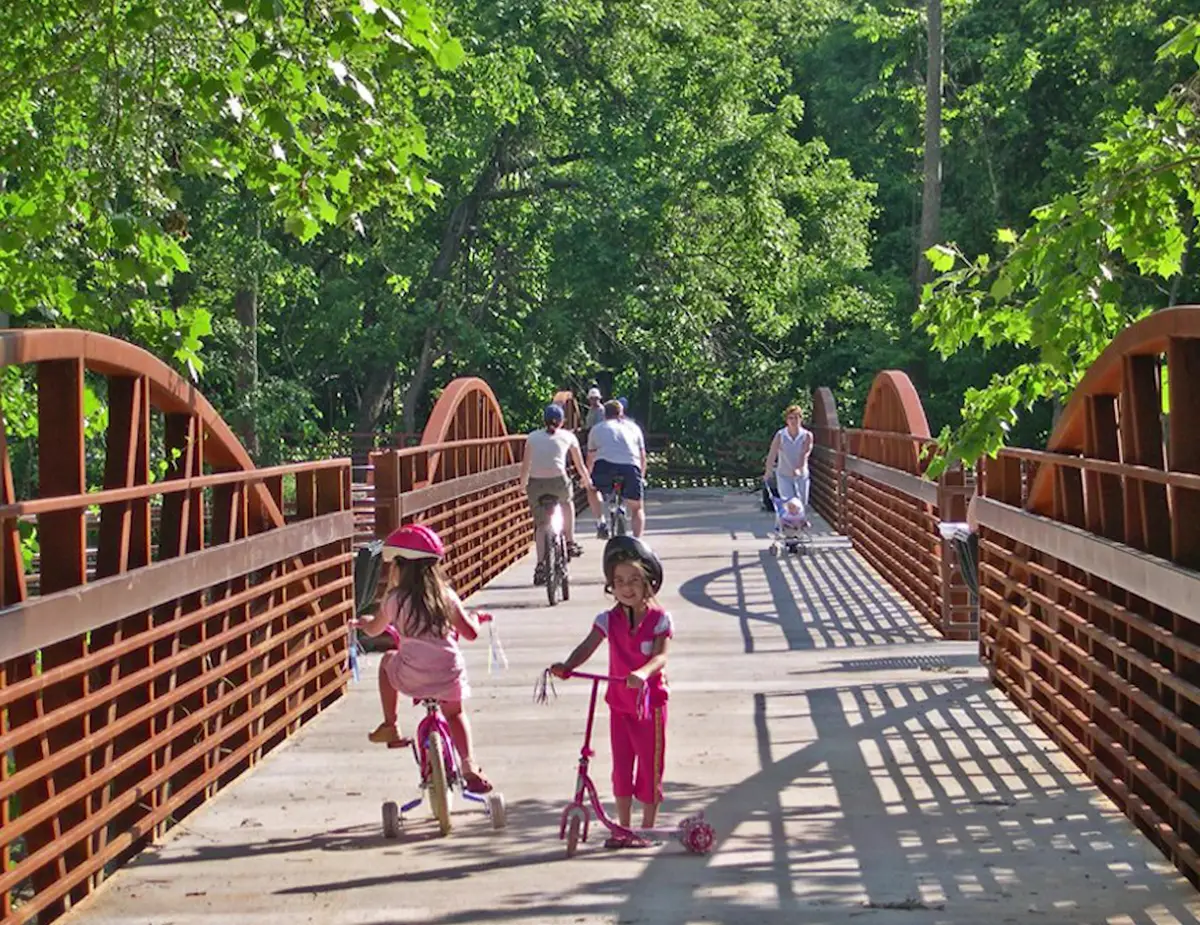
Razorback Greenway: Big Improvements Coming, Fayetteville to Bentonville
There is now an adopted long-range plan for the Razorback Regional Greenway in Northwest Arkansas, and it is more ambitious than "add some trail." The Northwest Arkansas Regional Planning Commission — not the Razorback Greenway Alliance, the seven-city nonprofit that handles day-to-day stewardship, which is who I said it was on camera — adopted the Razorback Greenway Corridor Plan on February 25, 2026. The commission credits the landscape architecture firm Field Operations with the design work and a Walton Family Foundation grant with funding it. Three themes in the plan matter for anyone who rides, walks or lives near the trail.
1. From Recreation to Transportation
The plan's central idea is that the Greenway should function as an active transportation spine, not just a recreational trail. The commission's own language calls it a transportation spine, a public space and an organizing element for regional growth — explicitly guiding its long-term evolution as more than a place to go for a ride on Saturday.
That gap between recreation and commuting is obvious to anyone who uses the trail. Commuting by trail already works in Bentonville and parts of Fayetteville. In the newer parts of Springdale and Rogers, not so much.
As NWA keeps growing and more jobs concentrate in Fayetteville, Springdale, Rogers and Bentonville, the argument for getting people out of cars gets stronger. Bike or scooter, it does not matter which. Right now the people I know who actually commute by trail mostly work at Walmart and live near it, which tells you the infrastructure is doing its job in exactly one corridor.
I do not know how you make that shift happen — that is their job, not mine. But I suspect it is less complicated than it sounds: put the path in the right place, protect it properly where it meets the road, and people who feel safe riding from their house in Fayetteville into downtown will start doing it. Once enough people see the benefit, it spreads on its own.
2. Shade and Water
The second theme is making the corridor pleasant to be on. Fayetteville has tons of trees. The Springdale-to-Rogers middle section has noticeably fewer — not because anyone cut them down, but because that stretch was farm fields.
The plan calls for planting thousands of additional trees for shade along the corridor, according to the commission and the design team. I have seen a specific figure quoted for how many, and I cannot source it, so I am not going to repeat a number I cannot stand behind. The direction is clear enough: more canopy, in the places that currently bake in July.
The part I am most interested in is the water. The plan includes restoring the creek corridors the trail runs along — softening banks, replanting vegetation, stabilizing with natural materials, and building what the designers call sponge parks to absorb stormwater. Years of thin vegetation on steep banks have caused erosion and sediment problems, and this addresses the cause rather than the symptom.
I am not a tree grower or a creek builder. What I do know is that when this trail system says it is going to do something, it generally does. Plan on real change over the next five years.
3. Destinations Instead of Just Distance
The third theme is destination connectivity: making the Greenway a place you stop rather than a corridor you pass through. The plan targets specific gaps and specific places — Kessler Park in Fayetteville, downtown Springdale, uptown Rogers, the Bentonville destinations.
Fayetteville is already good at this and is the model worth copying. The trail sections there have grade changes, roundabouts, tree cover, creeks, places to stop, and businesses within a few steps of the path. It reads as an experience rather than a route.
Bentonville has done the same thing around the Walmart home office campus, which the city says carries roughly seven miles of internal bike trails tying directly into the Greenway, with coffee and food a few steps off the path.
The middle — Springdale to Rogers, and parts of Bella Vista — is where the work is. Right now it is a good path with not much reason to stop. That takes time, money and energy, and NWA has been unusually good at supplying all three.
The Greenway runs 40 miles and links seven cities: Fayetteville, Johnson, Springdale, Lowell, Rogers, Bentonville and Bella Vista. In my opinion it is already one of the best regional trail systems in the country. This plan is about it getting better.