Texas Students Don't Get In-State Tuition Here
Author
Phillip Shepard
Date Published
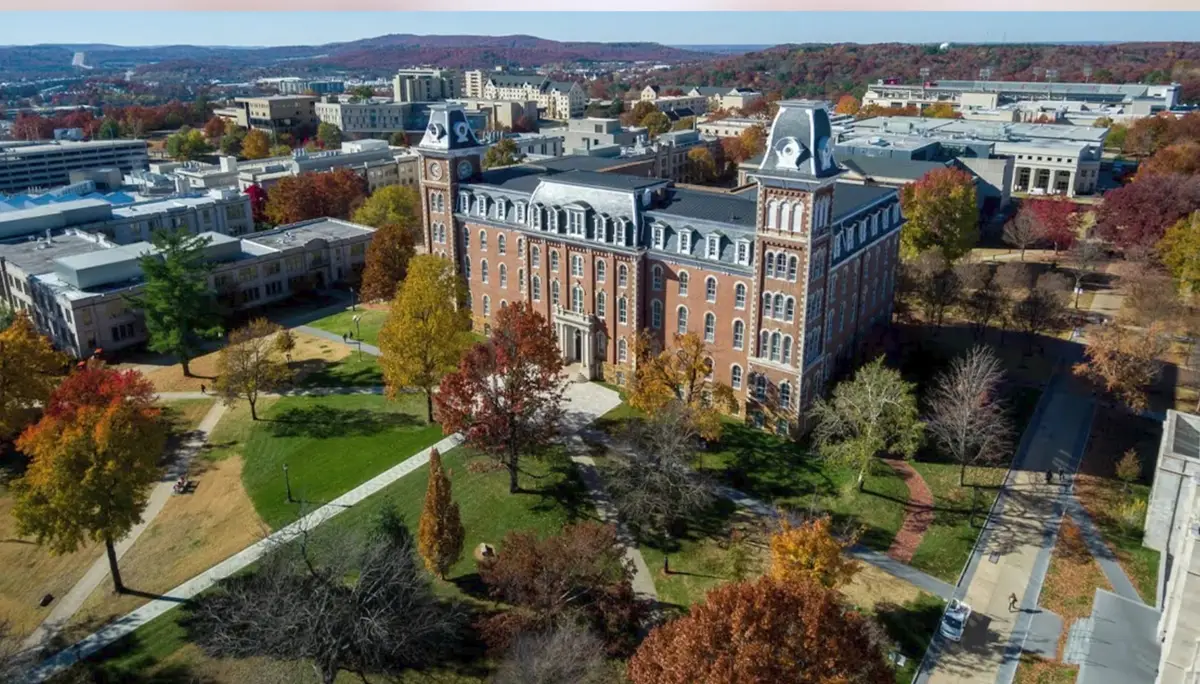
Texas students do not get in-state tuition at the University of Arkansas. In this video I said it flatly, with no conditions attached: "if you are a resident of Texas and choose not to go to a Texas University you can actually go to University of Arkansas for in-state tuition." I called it "a little bit of a marketing hack" and "a big marketing style that actual Arkansas uses all the time."
There is a real program underneath that. It is not in-state tuition, it is conditional on grades, and the gap between what I said and what a family would actually pay runs from about $2,200 to more than $22,000 a year.
This is the correction I most want people to see, because someone could budget four years of college on my version of it.
What the program actually is
It's the New Arkansan Non-Resident Tuition Award. It's a percentage discount off the difference between resident and non-resident tuition — not a waiver, and not in-state rates.
Texas is one of nine "surrounding" states that get the top tier, along with Georgia, Illinois, Kansas, Louisiana, Mississippi, Missouri, Oklahoma and Tennessee. For incoming freshmen from those states, the award is scaled by high school GPA:
- 3.80 or above — 90% of the tuition difference
- 3.60 or above — 80%
- 3.20 or above — 70%
- Below 3.20 — nothing
Here's what that means in dollars. At current rates for 30 credit hours, Arkansas resident tuition is $8,336 and non-resident tuition is $30,604 — a difference of $22,268.
- A Texas student with a 3.80+ pays about $10,563 — still roughly $2,227 more than an Arkansan
- At 3.60 they pay about $12,790 — $4,454 more
- At 3.20 they pay about $15,016 — $6,680 more
- Below a 3.20, they pay the full $30,604 — $22,268 more
So even the best-case student doesn't reach in-state tuition. And note where the cliff sits: a student at 3.20 pays about 1.8 times the Arkansas rate, while a student just below it — a 3.0, an ordinary B average — gets nothing at all and pays 3.7 times. The award also applies to tuition only; mandatory fees of roughly $2,580 are unchanged either way.
Some practical details I should have given instead of a slogan: it's automatic — there's no separate scholarship application, just apply for admission by the February 1 deadline. It's GPA-driven rather than test-score-driven. And it renews with a 2.75 cumulative GPA and 24 credit hours a year.
Is there any true in-state pathway for Texans? Two narrow ones. University policy dating to 1965 classifies residents of Texarkana, Texas and Bowie County as in-state — geographic, not statewide. And the SREB Academic Common Market grants in-state rates for specific degree programs not offered in a student's home state — program-by-program, not a blanket benefit. There is no general Arkansas-Texas reciprocity agreement.
Anyone actually running these numbers should get them from the university's financial aid office rather than from me, since rates change annually.
The one part I had right is the framing: this really is a recruitment tool, and it's working. Just under 49% of U of A students are Arkansas residents, meaning out-of-state students are now a slight majority.
The $3 billion — real study, invented split
I said "a study finally came out... per annual basis the actual University brings $3 billion to Arkansas." That's accurate. It's The Economic Impact of the University of Arkansas, released September 2024 on 2023 data, and the headline figure is $3.0165 billion, supporting nearly 19,000 jobs.
One refinement: that total is $2.494 billion in recurring annual impact plus $522 million in one-time construction impact. So the number that repeats every year is $2.5 billion.
Then I extrapolated. I said: "in my opinion obviously let's say probably 75% of that actually gets dumped into Northwest Arkansas... brings about let's say 2.5 on a very conservative scale, $2.5 billion into just almost just Fayetteville."
I did flag it as mine — "in my opinion," "let's say" twice — and that's the right instinct. The problem isn't that I estimated. It's what I estimated from.
The $3 billion is a statewide figure, and the report contains no Northwest Arkansas or Fayetteville total at all. (Note the collision of numbers: the $2.5 billion I mentioned above is the statewide recurring portion. The $2.5 billion I claimed on camera was supposedly Fayetteville's share. Same figure, unrelated bases.) There's no regional subtotal anywhere in the document. The 75% is my arithmetic, not the study's — and I called it "conservative" while providing no basis for it whatsoever.
The math doesn't even reach my own conclusion. 75% of $3.0 billion is $2.26 billion, not $2.5 billion. And then I attributed that to "almost just Fayetteville," which is a third leap on top of two unsupported ones.
What the report does contain are regional line items, which is probably what I half-remembered: $569.4 million in student spending in Northwest Arkansas in 2023, with 82% of students living in Fayetteville, and $262.2 million in visitor impact, of which $154.6 million is Razorback baseball, basketball and football. Those are components, not a regional total.
And it's worth saying what an economic impact study is. This one was produced by a research center inside the university being measured — not an independent audit. The $3 billion isn't money the university hands to Arkansas. Direct in-state spending was $1.1 billion; the model applies an output multiplier of about 2.8 to estimate the ripple effects as those dollars change hands. That multiplier is an assumption. The figure also includes activity that would exist in some form anyway, and it doesn't net out the state's $220.3 million in annual appropriations.
It's a standard, legitimate methodology. It measures gross economic activity associated with an institution, not net value created — and that's a meaningfully different thing from what "brings $3 billion to Arkansas" sounds like.
Enrollment: my most accurate claim
I said "33,600 students have registered for this fall total. That's 22% over 5 years," and noted I was reading the data.
Both figures are essentially verbatim from the university's release. Fall 2024 enrollment was 33,610, up 4.6% year over year, and up 22% over the previous five years. I'll take that one.
The update: fall 2025 broke the record again at 34,175 — 29,260 undergraduate, 4,915 graduate — the fifth consecutive record year and up 24% since 2020.
Where I was wrong is the contrast. I said "other universities are struggling whether it's due to price or location or whatever the case is."
National enrollment has been growing since 2022. Fall 2025 total postsecondary enrollment rose 1.0% and undergraduate enrollment rose 1.2% — and the growth was concentrated exactly where the U of A sits: public four-year institutions up 1.4%, community colleges up 3.0%. The declines are at private nonprofit four-year schools, down 1.6%, and for-profits, down 2.0%.
So the U of A is outperforming the national average, which is genuinely good. It's riding a national public-university recovery, not standing alone against a collapse.
One more thing I overstated: I said "it's very rare to have native people here." I couldn't find an Arkansas-born share for the metro. What I can say is that even the most native-heavy Arkansas counties run around 62 to 64% Arkansas-born, and Northwest Arkansas — one of the fastest-growing metros in the country — is well below that. "A large and growing share of people here are transplants" is supportable. "Very rare" isn't.
The restaurant, the minister, and a quote I can't source
This is the part that needs a retraction rather than a correction.
The restaurant is real and I can name it now. I said I'd butcher the name so I wouldn't try. It's Junto, a Japanese restaurant from The Indigo Road Hospitality Group in the lobby of the Motto by Hilton Bentonville Downtown at 229 S. Main Street — directly across from The Ledger, exactly as I described. The menu was curated by James Beard Award-winning chef Masa Hamaya: omakase, sashimi, nigiri, seasonal plates. A tropical bar, Bar Kapu, opened alongside it. Both were open by September 2024; the hotel's ribbon-cutting was October 30, 2024.
The visit is real too, with corrections. I said "one of the actual political ministers from Japan came to visit Bentonville a couple weeks back to do some deals with rice with the Waltons in Arkansas."
The official was Norikazu Suzuki, then a state minister — a vice-minister-level position — in Japan's Ministry of Agriculture, Forestry and Fisheries. Not a cabinet minister; he didn't become Japan's full Minister of Agriculture until October 2025. The visit was reported August 30, 2024.
And no reporting supports the Walton connection. He toured Northwest Arkansas with Phil Libin, co-founder of the virtual restaurant Bentoville and CEO of All Turtles, and Hitoshi Hokamura of All Turtles. He said his team chose the region for its growth trajectory and business potential, and was interested in copying Bentonville's mountain-biking model to revitalize rural Japan — which is a better story than the one I told.
Now the quote. I said he "tried this food and he said that this is some of the most authentic and also great sushi he's had even in comparison to Japan."
I can't find that quote anywhere. Not in the reporting on the visit, not in any outlet. I also can't pin down which trip I was describing precisely enough to check it against a date.
Either way, I attributed specific, flattering, evaluative praise to a named foreign government official about a named business, with nothing behind it. I'd withdraw it entirely. Junto may well be excellent — I have no reason to think otherwise and I still want to go — but nobody should choose a restaurant because I said a Japanese minister blessed it.
Southern Living — genuinely unresolved
I said Southern Living "did another full page spread on Bentonville. They sent one of their editors to Bentonville and did a two-day in the life."
I couldn't confirm it. That's not the same as saying it didn't happen — I couldn't get at Southern Living's archive to check, so this is a gap in my verification rather than a finding. Southern Living has published a "25 Best Places To Go In The South" list that may be what I'm thinking of, and Garden & Gun ran a feature on biking the Northwest Arkansas trails that I could be conflating with it.
I'm flagging it as unconfirmed rather than guessing in either direction. I've had to learn the hard way that "I couldn't find it" and "it doesn't exist" are different sentences — I got exactly that wrong about a Bentonville apartment complex and had to go back and fix a published post.
One item I'd just drop: I said "to actually borrow the logo for a year is $125,000." I can't find any public basis for that number. The university licenses its marks through the Collegiate Licensing Company with multiple tiers, and collegiate licensing normally works as a royalty on sales plus an advance, not a flat annual fee. Fee schedules aren't published. I hedged its importance on camera — "I guarantee that's not going to be their bread and butter" — and I'd go further and remove the figure.