NWA Building Pauses: Sewer Limits & Missing Middle
Author
Phillip Shepard
Date Published
Living in Bentonville: Why Some NWA Towns Can't Build Houses Right Now
More than 400 developers, builders, mayors and residents recently packed into a single room in Fayetteville to work through one question: how does Northwest Arkansas keep building? The region is expected to pass 1 million people by around 2050, and in a handful of places the pipes, pumps and approval processes are not keeping up. Here is what came out of that meeting, where building is actually on hold, and what it means if you are planning a move to Bentonville or anywhere else in NWA.
Why This Is Not Doom and Gloom
It is easy to read headlines about infrastructure shortfalls and conclude the region has outgrown itself. That is not what is happening. A room full of mayors, planners and builders working on these problems before they get bigger is exactly what a well-run region looks like. Most of the issues discussed are showing up at a small scale today and would become real problems only if nobody addressed them.
NWA also starts from a better position than most fast-growing areas. Fayetteville has mapped its growth out to 2040 in City Plan 2040 — what will be commercial, where roads and trails will go — and Bentonville and Rogers have done similar long-range planning. The region also has unusual financial backing from the Walton family, the Tyson family, J.B. Hunt and a deep bench of nonprofits. What the region is dealing with now are detours, not a missing map.
1. Infrastructure Is the Real Bottleneck
Infrastructure was the biggest topic at the meeting. The region is not uniformly behind; the core of Bentonville, Pea Ridge, Springdale, Rogers and Fayetteville is well served. The problem is that some cities approved build-outs in areas that were not ready for them, and the water and sewer lines never caught up.
The price tag is large. A wastewater study the state is running with the Northwest Arkansas Council is expected to identify more than $1.5 billion in needed improvements across the region. What has to get built is simpler to describe: more wastewater treatment capacity, more water treatment capacity and the pipelines to carry both to new neighborhoods. The raw water supply is not the constraint — Beaver Water District and Beaver Lake have that covered. What is missing is the pipe, pump and treatment capacity to serve areas nobody expected to fill so quickly.
A few places where that is already slowing construction:
- Southern Bentonville, where new build-outs have been held up in some areas because the sewer system is near capacity
- Prairie Grove, which set a moratorium in April 2026 on new residential sewer connections in parts of town until lift-station capacity is expanded
- An area outside Fayetteville, which lacks a pump station and is effectively off-limits for now
- Centerton, which grew faster than expected and relies on a contract with the small city of Decatur for much of its wastewater treatment
Bentonville is the city that got caught furthest behind. In late 2025 the Alice L. Walton Foundation offered the city a $239 million loan for sewer upgrades, which the city council approved in December. The 20-year loan is repaid through one-time wastewater development fees that the City of Bentonville now charges on new construction. It is fair to extend Bentonville some grace: very few cities go from a quiet small town to one of the most talked-about places in the country as quickly as it has, and nobody plans perfectly for that.
2. The Missing Middle
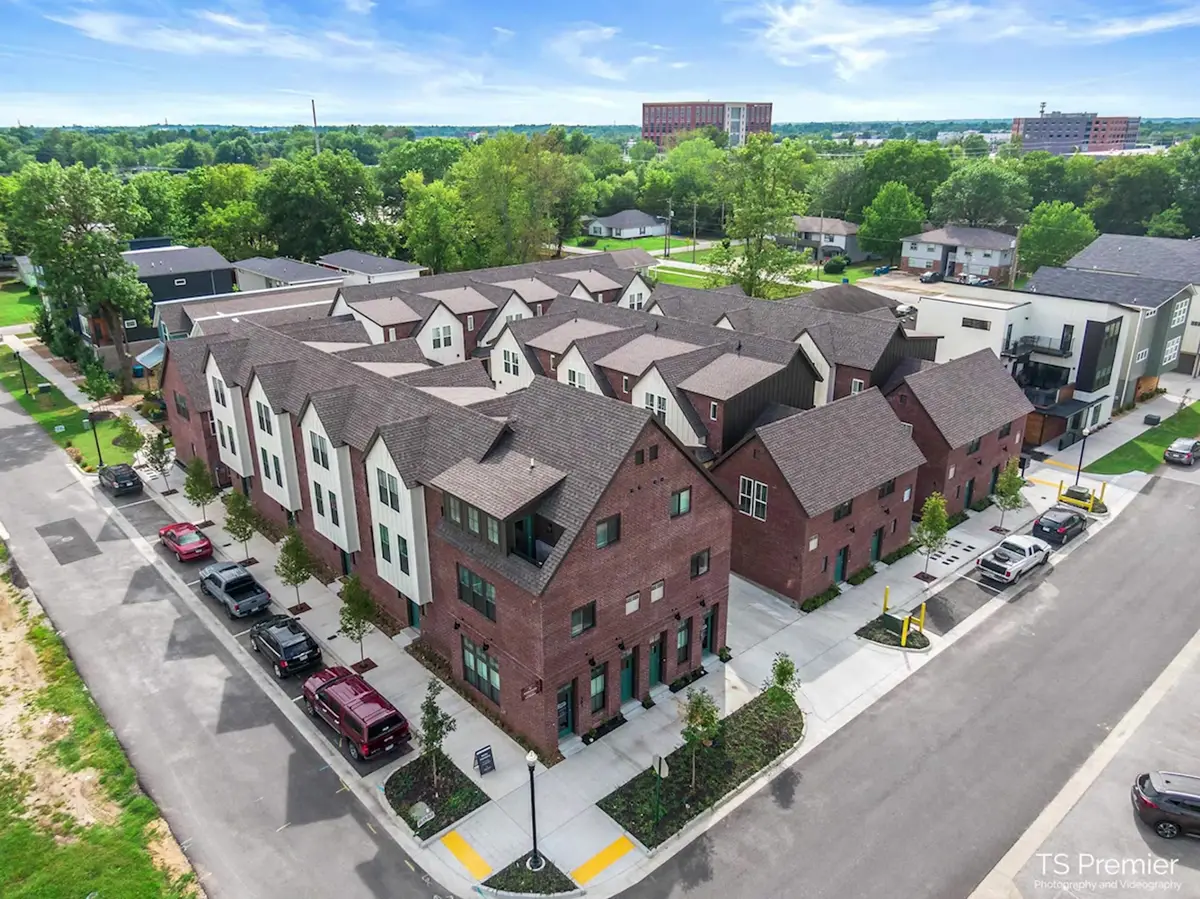
The second major topic was the kind of housing getting built. The council's regional growth strategy, released in April 2026, calls for a wider range of housing types. The region has plenty of single-family homes, plenty of large homes, plenty of commercial space and a steady supply of apartments across Fayetteville, Bentonville, Lowell, Springdale and Rogers. What it lacks is the missing middle: condos and townhouses built to be sold rather than rented.
Two things keep that housing from getting built:
- Tax incentives favor rentals. Developers get more benefit from holding a building and depreciating it than from building condos and selling them off.
- Approvals are slow. Much of the zoning rewrite work is already done. What is still needed is for city planning offices to make the approval process simpler and faster across the board.
Developers at the meeting, including some from Texas and other states, made clear they want to build this kind of housing. The demand is there too. Many of the relocating buyers I work with do not particularly want a single-family house, but buy one because nothing else is available to purchase. A townhouse or condo would fit a lot of them better, and would give the market a step between renting an apartment and owning a detached home.
What It Means If You Are Moving Here
Expect for-sale condos and townhouses to become a recurring theme. My expectation is that noticeably more of those options will reach the market within about two years, as approvals ease and more developers commit to building them.
In the meantime, the infrastructure pauses are local, not regional. If you are shopping new construction on the edges of Bentonville, Centerton or Prairie Grove, it is worth asking whether a subdivision's sewer and water service is already in place or still waiting on a pipeline. Most of NWA is building normally. The places that are not are known, being worked on and, in Bentonville's case, already funded.